
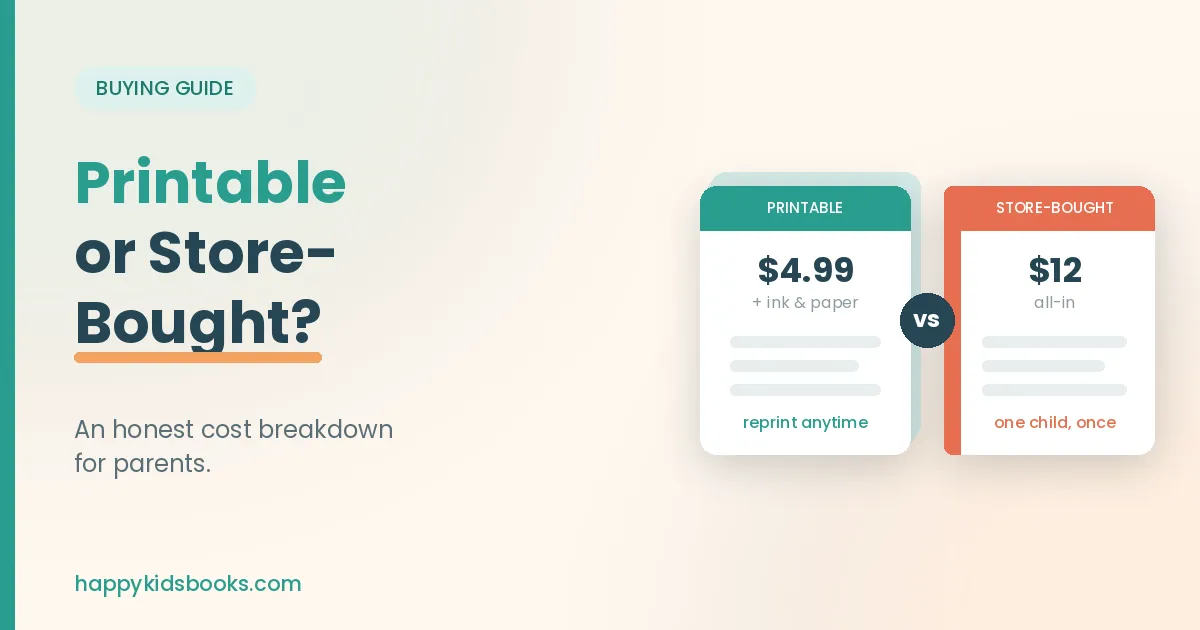
Printable workbooks cost less up front but add ink and paper. Here is an honest cost comparison, where each format wins, and the one question that decides it.
Quick answer
Printable workbooks are worth it for skills your child practices over and over, like handwriting, cutting, letter sounds and number formation, because you can reprint the pages as often as you need. Store-bought books win for one-time content like puzzle books and story collections. If you have a printer and your child likes repeating pages, printables are usually the better value.
You’ve found a printable workbook you like. It’s a PDF, it costs a few dollars, and it downloads instantly. Then the doubt arrives: wouldn’t it be simpler to just buy a real workbook from the store?
It’s a fair question, and the honest answer is that it depends on things most comparison articles skip — like whether you own a printer, and whether your child is the kind who wants to do the same page four times.
Here’s how the two actually compare.
What a printable really costs
The sticker price isn’t the whole picture, so let’s do the math properly.
A printable workbook priced around $5 has no per-page cost until you print it. Printing at home adds roughly:
- Paper: about 1¢ per sheet for standard copy paper
- Black-and-white ink: roughly 3–5¢ per page on an inkjet, less on a laser printer
- Color ink: considerably more, often 10–20¢ per page for heavy coverage
These are rough estimates and vary a lot by printer and cartridge. But the pattern holds: line-art pages are cheap to print, full-color pages are not.
This matters for what you buy. A tracing, cutting, or phonics workbook is mostly black line work on white, so printing costs stay low. A dense full-color activity book is a different story — if you’re printing 60 saturated color pages at home, you may spend more on ink than the download cost.
A store-bought workbook has none of that. You pay $8–$15 once and it arrives finished, bound, on decent paper.
Where printables genuinely win
You can reprint the same page. This is the big one, and it’s the thing store-bought books physically cannot do. When your child struggles with cutting curves, you print that page five more times. In a paper book, once it’s filled in, it’s finished. For any skill built through repetition — letter formation, scissor control, sight words — this alone can justify the format.
You print only what you need. Most store-bought workbooks contain a lot your child has already mastered or isn’t ready for. You paid for all of it. With a PDF you print page 12 and skip the rest.
It works for more than one child. A printable bought once serves siblings, cousins, or a whole classroom. A paper book serves one child, once.
No waiting and no shipping. Useful at 9pm the night before a long flight.
You can size it for small hands. Printing a tracing page slightly enlarged makes a real difference for a three-year-old still building grip strength. Our fine motor skills checklist covers which skills benefit from this.
Where store-bought genuinely wins
I’d rather be straight with you about this than pretend printables are always better.
No printer, no printable. If you don’t own one, printables mean a trip to a print shop, and at that point the convenience argument collapses.
Binding matters for some kids. A bound book feels like a book. Some children are far more motivated by working through something that looks like a real object than by a stack of loose sheets. If that’s your child, respect it.
Paper quality. Store workbooks often use thicker stock that holds up better to markers and erasing. Standard copy paper tears when a determined four-year-old erases hard.
Gifts. A PDF is a poor birthday present.
Zero setup. No file management, no printer settings, no paper jams at bedtime.
The question that actually decides it
Forget price for a moment and ask this instead:
Is this a skill my child will practice repeatedly, or work through once?
Repetition skills — handwriting, cutting, letter sounds, number formation — favor printables, strongly. The ability to reprint is worth more than the binding.
One-pass content — puzzle books, story collections, activity books meant to be enjoyed and finished — favors store-bought. You aren’t going to redo a maze.
That single question resolves most cases more cleanly than any cost comparison.
Getting printing right
Most disappointment with printables comes down to printer settings rather than the file.
Print at 100%, not “fit to page.” Scaling shrinks everything and throws off letter sizing on handwriting pages. Look for “Actual size” or set scale to 100%.
Check your paper size. US Letter and A4 are different. A good printable offers both — if it only offers one and it isn’t yours, expect margin problems.
Use draft mode for practice pages. Nobody needs photo-quality ink on a page that’ll be covered in crayon.
Slightly heavier paper helps. Around 28lb instead of standard 20lb copy paper makes a noticeable difference for markers, and costs very little more.
A reasonable middle ground
Most families end up using both, and that’s sensible.
Printables for the skills that need drilling. Store-bought for the books your child carries around, takes in the car, and treats as theirs.
If you’re starting out, pick one printable targeting the specific skill your child is stuck on right now, rather than a broad everything-pack. Narrow beats comprehensive when you’re testing whether the format suits your family at all.
Frequently asked questions
Are printable workbooks cheaper than store-bought ones?
Often, but include printing costs. Printables save the most when you reprint pages your child repeats, such as tracing and cutting practice.
Can I print a workbook more than once?
Most printable workbooks allow unlimited printing for your own family, so check the license. Happy Kids Books workbooks can be printed as often as you like at home.
What paper is best for printable workbooks?
Standard printer paper works for most pages. Slightly heavier paper helps with cutting practice and coloring with markers.
Do I need a color printer for printable workbooks?
No. Most pages work fine in black and white, and many children enjoy coloring the pages themselves.
Where to start
If your child is working on cutting, the Scissor Skills Workbook for Ages 3–5 is built around reprintable practice — the exact case where the format earns its keep.
For early reading, the Decodable Passages Pack covers 32 stories you can reprint as often as a passage needs revisiting.
For sight word practice, the Safari Sight Words Workbook covers ages 5–9, and our kindergarten readiness checklist will help you work out which skills to target first.
And if you’re still weighing up the format itself, our guide to what activity books actually do for learning is a useful next read.
Get new printables in your inbox
Join other parents getting new printable pages, freebies and simple at-home learning tips. No spam, unsubscribe anytime.