
A simple checklist of what most 4 year olds know academically, based on CDC milestones, with easy ways to practice reading, writing and math at home.
Quick answer
Most 4 year olds can name a few colors, speak in sentences of four or more words, retell part of a familiar story, draw a person with three or more body parts and hold a crayon between fingers and thumb. Counting to 10, naming some letters and writing a few letters of their name usually come during the following year, by age 5.
If you have a 4 year old, you have probably wondered whether they are “on track.” Should they know their letters yet? Count to 20? Write their name?
The honest answer is that 4 is an age of huge variety. This checklist shows what most children can do by 4, what usually comes by 5, and simple ways to practice at home without turning your living room into a classroom.
What do the CDC milestones say about 4 year olds?
The CDC’s developmental milestones list skills that most children (75% or more) can do by a certain age. For thinking and learning at age 4, the CDC lists naming a few colors, telling what comes next in a well-known story and drawing a person with three or more body parts (CDC milestones by 4 years).
For many “school” skills, like counting to 10 or naming letters, the CDC lists them at age 5 (CDC milestones by 5 years). That means the year between 4 and 5 is when these skills are building, not when they must already be finished.
Academic checklist for a 4 year old
| Skill area | Most children by age 4 | Usually developing by age 5 |
|---|---|---|
| Language | Sentences of 4+ words; talks about something from their day; answers simple questions | Tells a story with at least two events; keeps a conversation going |
| Reading readiness | Says some words from songs, stories or rhymes; tells what comes next in a known story | Recognizes simple rhymes; names some letters when you point to them |
| Writing readiness | Holds a crayon between fingers and thumb; draws a person with 3+ body parts | Writes some letters in their name |
| Math | Names a few colors; starts counting small groups of objects | Counts to 10; names some numbers between 1 and 5 |
| Attention | Plays with one activity for a few minutes | Pays attention for 5 to 10 minutes during story time or crafts |
Milestone items in this table are summarized from the CDC’s age 4 and age 5 milestone lists. The “starts counting small groups” line is a common early math step, not a CDC milestone.
Reading readiness: what to practice at 4
- Rhyming. Play “what rhymes with cat?” in the car. Rhyming is one of the first steps toward reading.
- Letter names and sounds. Start with the letters in your child’s name. Our letter recognition activities for preschoolers make this playful.
- Story talk. After a book, ask “what happened first?” and “what happened next?”
Writing readiness: what to practice at 4
- Pencil grip. Short crayons encourage a finger-and-thumb grip instead of a fist.
- Tracing. Lines, curves and zigzags come before letters.
- Cutting. Scissor practice builds the same hand strength used for writing. See our fine motor skills checklist for what to look for.
Practice every skill on this list, 10 minutes a day
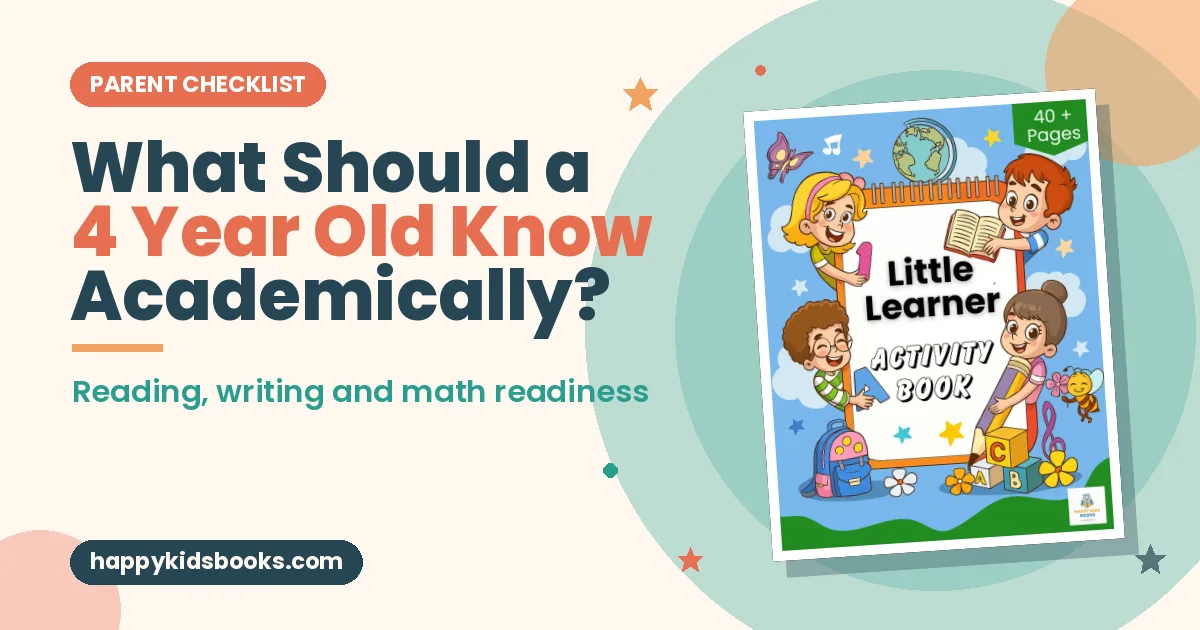
The Little Learner Kindergarten Readiness Workbook has 40+ printable worksheets for ages 3 to 6, covering letters, numbers, shapes, tracing, matching and fine motor skills. Print a page a day and track progress as you go.
Math readiness: what to practice at 4
- Counting real things. Count stairs, grapes and shoes, touching each one as you say the number.
- More and less. “Who has more blocks, you or me?”
- Shapes in the world. Spot circles, squares and triangles on a walk.
- Number order. Dot-to-dot puzzles are a quiet way to practice counting in order.
Social and thinking skills matter just as much
Kindergarten teachers often say the most useful skills are not academic at all. Taking turns, following a two-step instruction, asking for help and sitting for a short story make a bigger difference in the first weeks of school than knowing every letter. Our kindergarten readiness checklist covers these alongside the academic skills.
When should you talk to a doctor?
Every child develops at their own pace, so missing one item is rarely a concern on its own. If your child has lost skills they once had, or you notice they are not meeting several milestones for their age, talk to your pediatrician. The CDC also suggests acting early if you have concerns, because support works best when it starts early.
Frequently asked questions
Should a 4 year old know the alphabet?
Not completely. Many 4 year olds know some letters, especially the ones in their name. The CDC lists naming some letters as a milestone by age 5, so the year between 4 and 5 is when most children build this skill.
How high should a 4 year old be able to count?
Many 4 year olds can count small groups of objects and recite numbers past 10, but counting to 10 is listed by the CDC as a milestone by age 5. Counting real objects one by one matters more than reciting high numbers.
Should a 4 year old be able to write their name?
Some can, but many cannot yet. Writing some letters of their name is a CDC milestone by age 5. At 4, focus on grip, tracing and drawing.
What should a 4 year old know before pre-K?
Helpful skills include using the bathroom independently, following simple instructions, naming a few colors, speaking in short sentences and holding a crayon. Academic skills like letters and numbers are taught in pre-K itself.
How can I help my 4 year old learn at home?
Read together every day, count objects during routines, play rhyming games and offer 10 minutes of tracing, cutting or coloring. Short, playful practice works better than long lessons.
The bottom line
A 4 year old does not need to read, write or do sums. They need lots of talk, stories, play and small amounts of hands-on practice. Use the checklist as a guide, celebrate what your child can already do and build the rest one playful page at a time.
Get new printables in your inbox
Join other parents getting new printable pages, freebies and simple at-home learning tips. No spam, unsubscribe anytime.