
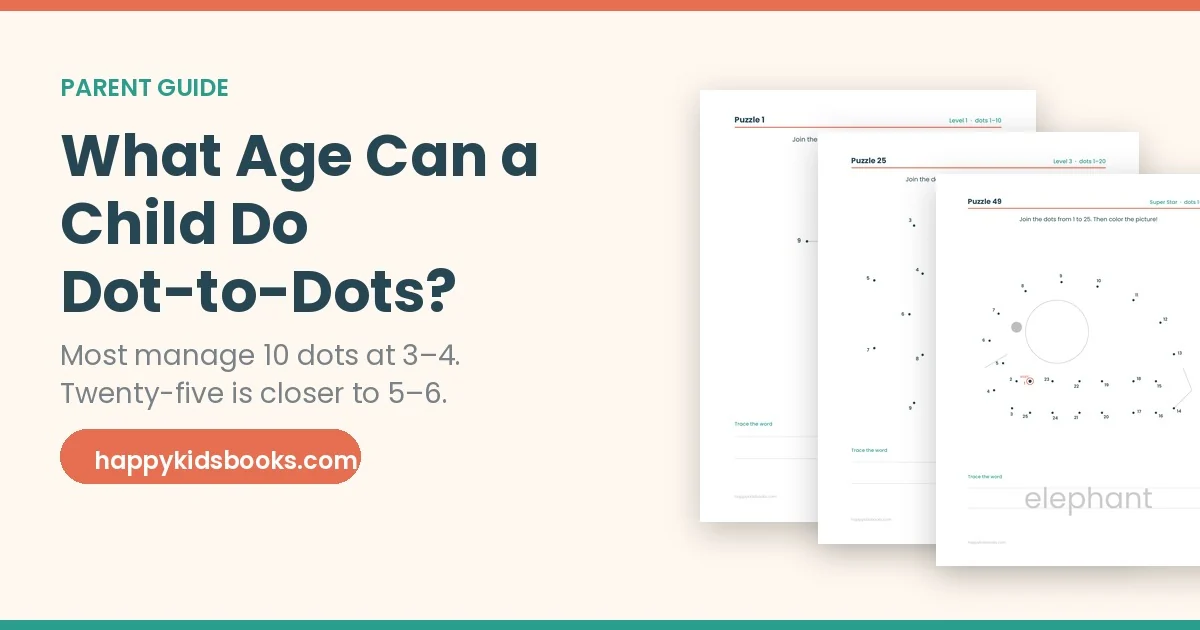
Most children manage simple dot-to-dots around age 3-4, but only with the right number of dots. Here's what to expect at each age, and why 25 dots is too many.
Quick answer
Most children can do a simple dot-to-dot with about 8 to 12 dots between ages 3 and 4. By 4 to 5 they usually manage 12 to 20 dots, and the standard 25-dot puzzle is realistic around ages 5 to 6. If your child gets stuck, the problem is usually recognizing numbers past 10, not drawing the lines.
Most children can manage a simple dot-to-dot somewhere between ages 3 and 4 — but only if the puzzle has around ten dots. The standard 25-dot puzzle found in most books is realistic closer to age 5 or 6. The gap between those two numbers is why so many dot-to-dot books end up abandoned in a drawer.
Here is what to expect at each age, and what to do if your child is struggling.
The short answer, by age
| Age | What they can usually manage | Realistic dot count |
|---|---|---|
| 2–3 | Drawing a line between two marked points, with help | 3–5 dots, or none yet |
| 3–4 | A simple closed shape, counting aloud as they go | 8–12 dots |
| 4–5 | Recognizing numbers past 10, working more independently | 12–20 dots |
| 5–6 | Full sequences, correcting their own mistakes | 20–30 dots |
| 6+ | Complex puzzles, alphabet and skip-counting variations | 30+ dots |
These are typical ranges, not milestones. Children vary enormously, and a child who is behind on one of these and ahead on another is completely ordinary.
Why the age question is really three questions
A dot-to-dot looks like one simple task. It is actually three separate skills happening at once, and a child can be perfectly capable at two of them while the third is still developing.
Can they say the numbers in order? Most children can recite numbers to ten somewhere around age three, and to twenty around age four or five. But reciting is not the same as recognizing. A child who can happily count aloud to twenty may not be able to look at a printed “14” and know what it is. Dot-to-dots require the second skill, not the first.
Can they count one thing at a time? This is called one-to-one correspondence — touching one object for one number word, without skipping or doubling up. It usually settles around ages three to four. Before it does, a child will count “one, two, three, four” while pointing at two dots, and the picture never appears.
Can their hand do what their eye wants? Drawing a controlled line between two fixed points is harder than scribbling. Around three, most children can copy a circle. A cross comes closer to four, a square around four to five. If your child cannot yet copy a circle, the dots themselves are not the problem — the pencil work is.
A three-year-old is often solid on the first, wobbly on the second, and just beginning the third. That combination handles ten dots comfortably and falls apart at twenty-five.
What dot-to-dots actually teach
It is worth knowing what you are getting for the twenty minutes, because it is more than it looks.
Number order. Not just counting, but knowing what comes next from a standing start. A child who has to restart at one every time they lose their place is telling you something useful about where they are.
One-to-one counting. Every dot forces the pairing of one number to one object. It is the same skill underneath early addition.
Pencil control. Short, deliberate strokes between two fixed points, which is exactly the movement letter formation requires. Free drawing does not build this in the same way, because free drawing has no target.
Hand-eye coordination. The eye must locate the next dot before the hand moves. Watch a child do this and you can see the moment the two systems sync up.
Visual closure. This is the interesting one. Visual closure is the ability to recognize a whole object from incomplete information — seeing a scatter of dots and sensing a rabbit before the lines are drawn. It is one of the last visual perceptual skills to mature, and it matters for reading, because recognizing a word from partial visual information is the same underlying ability.
Vocabulary, if the book bothers. A finished picture is a conversation. What is it? Where have you seen one? What color should it be?
Why your child gives up around number seven
Here is the specific failure, and it is worth recognizing because it looks like something else.
A child opens a 25-dot page. They start confidently. Around dot six or seven they look up, scan the page for “8”, and cannot find it quickly. They scan again. The pencil hovers. They try a dot that looks about right, guess wrong, and the line goes somewhere strange. Now the picture is broken and they know it.
What happens next is not usually frustration with the puzzle. It is embarrassment. The child closes the book and says they do not want to do it, and the parent concludes their child does not like dot-to-dots.
They like dot-to-dots. They do not like failing at them in front of you.
The fix is almost always fewer dots, not more encouragement.
How to help a child who is struggling
Have them count out loud. This slows the hand to the speed of the voice, and it is the single most effective intervention. It also lets you hear exactly where the sequence breaks down.
Point to the next number, do not draw it. If they are stuck on “where is 12”, put your finger near it. Let their hand do the work.
Do not fix mistakes. If dot nine gets skipped, resist the urge to correct the line. Ask “which number comes after eight?” and let them find it. The recovery is the learning.
Drop a level, without announcing it. If twenty-five dots is not working, hand them a ten-dot page. Do not explain that it is easier. They will finish it, feel capable, and ask for another.
Color first, talk after. The puzzle is finished when the picture appears; the coloring is the reward. Do not rush them past it to the next page.
How to choose a dot-to-dot book
Three things to check before you buy, and only one of them is on most covers.
Does the difficulty change? This is the big one. Most books pick a single dot count and use it on every page. A book that starts at ten dots and works upward means one purchase covers a year of your child’s development instead of a fortnight of it.
How big are the numbers, and how far apart? Small numbers crammed against the dots are hard for young eyes to separate. The number should sit clearly outside the shape.
Is there an answer key? More useful than it sounds. When a child insists the picture is a horse and you think it is a dog, someone has to be able to check.
If you are also thinking about what else your child should be working on before school starts, our kindergarten readiness checklist covers the wider picture.
The book we made because of this
We built Dot to Dot 1-25 specifically to fix the difficulty problem.
It starts at ten dots and climbs: twelve puzzles at 1–10, twelve at 1–15, twelve at 1–20, then twelve at the full 1–25, and seven harder ones at the end. Fifty-five puzzles across seventy-two printable pages. A three-year-old can start on page one, and the same book is still useful when they are six.
Under every finished picture there is a word to trace, so the page that practices counting also practices letter formation. There is a warm-up page for tracing the numbers first, a progress chart to color in, a full answer key, and a certificate for the day the last puzzle is done.
It is an instant download, so you can print any page as many times as your child wants another go at it.
Frequently asked questions
My four-year-old can count to thirty but cannot do a dot-to-dot. Why? Almost certainly number recognition rather than counting. Reciting numbers and identifying a printed numeral are different skills, and the second lags the first by a year or more in many children. Try a ten-dot puzzle and see whether the problem disappears.
Is it worth doing dot-to-dots if my child already counts well? Yes, but for different reasons. For a confident counter the value shifts to pencil control and visual closure. Move them to higher dot counts so the counting stays slightly effortful.
How long should a session be? One or two puzzles. Ten to fifteen minutes. Stop while they still want another one — that is what makes them ask for the book tomorrow.
Are printable or paperback versions better? Printables can be reprinted, which matters more than it sounds when a child wants to do their favorite page four times. Paperbacks are easier in the car. We publish both.
My child draws the lines but will not color the picture. Is that a problem? No. Coloring and connecting are separate skills with separate appeal. Plenty of children love one and ignore the other.
Every workbook we publish is printed on ordinary home paper and used by a real child before it goes on sale. If something is not right, tell us and we will fix it.
Get new printables in your inbox
Join other parents getting new printable pages, freebies and simple at-home learning tips. No spam, unsubscribe anytime.