
Kindergarten readiness checklist with 50 skills covering literacy, maths, motor skills and independence. A practical guide for parents of 4–5 year olds.
Quick answer
Being ready for kindergarten is about everyday basics, not reading fluently. Most children starting school confidently manage around 30 to 40 of the 50 skills on this checklist, across language, early math, fine motor, self-care, social skills and following directions. The pattern of gaps matters more than the total.
If your child starts school in a few months, you have probably wondered whether they are actually ready. Most parents do. The good news is that being ready has very little to do with reading fluently or writing their full name neatly. This kindergarten readiness checklist covers the 50 skills that teachers genuinely look for, grouped into six areas so you can see at a glance where your child is confident and where a little practice would help.
Work through it slowly. There is no pass mark, and no child ticks every box on day one.
What “kindergarten ready” actually means
Ask a reception or kindergarten teacher what they want from a new starter, and very few will say phonics knowledge. What they mention first is almost always independence and self-regulation: can the child use the toilet alone, sit for a short story, ask for help, cope with being told no, and manage their own coat and lunch box.
Academic skills matter, but they are taught at school. The skills that are hard to teach to thirty children at once are the practical ones, and those are the ones worth practising at home. A useful kindergarten readiness checklist reflects that balance, which is why only about a third of the list below is academic.
Language and early literacy (10 skills)
At this stage the goal is comfort with language, not decoding. Can your child:
- Speak in full sentences that a stranger can understand
- Recognize their own name in print
- Say most letters of the alphabet, in any order
- Know the sound at least 10 letters make
- Recognize words that rhyme (cat, hat, mat)
- Clap out the syllables in a familiar word
- Hold a book the right way up and turn pages one at a time
- Sit through a short picture book without wandering off
- Retell what happened in a familiar story
- Answer a simple “why did she do that?” question about a story
If your child recognizes a handful of common words on sight, that is a bonus rather than a requirement. Our guide to how many sight words a child should know by age gives realistic targets if you want to look further ahead.
Early math and numbers (8 skills)
- Count out loud to 10, and ideally to 20
- Count a line of objects accurately by touching each one
- Recognize written numerals 1 to 10
- Understand more, less and the same
- Name the basic shapes: circle, square, triangle, rectangle
- Sort objects by color, size or shape
- Copy a simple pattern (red, blue, red, blue)
- Understand position words: on, under, behind, next to
Counting a row of objects one by one is the skill that matters most here. Plenty of children can chant to twenty but lose track when counting real things, and that gap is worth closing before school starts.
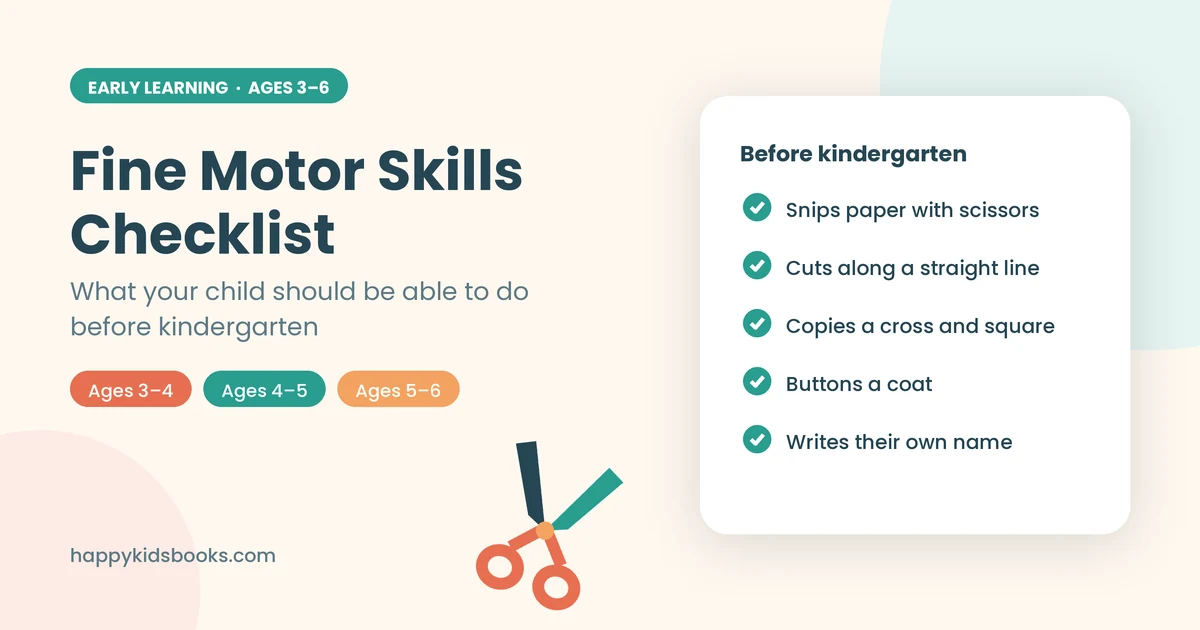
Fine motor skills (8 skills)
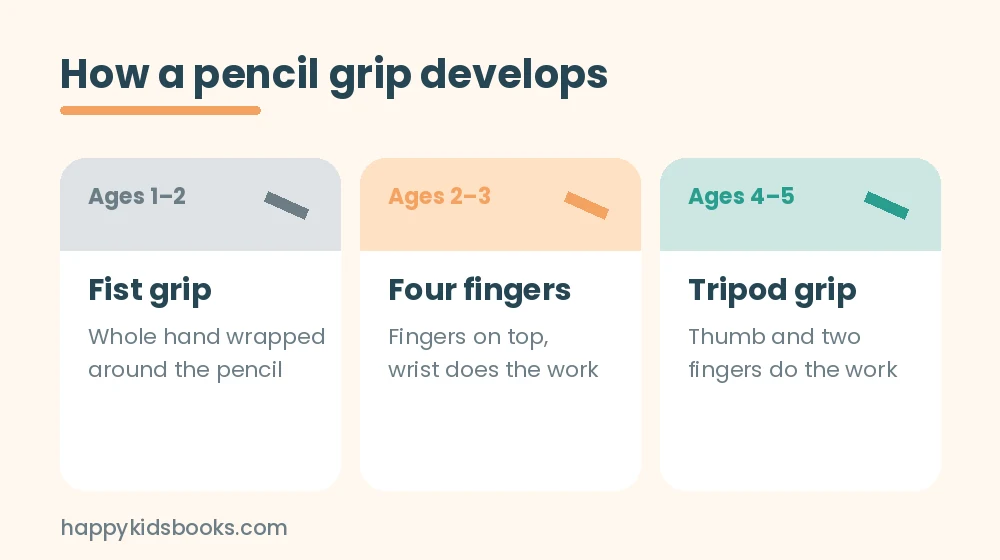
This is where many otherwise confident children need the most support, and it is the section of any kindergarten readiness checklist that responds fastest to a few weeks of practice.
- Hold a pencil or crayon in a tripod grip rather than a fist
- Draw a recognizable person with a head, body and limbs
- Copy simple shapes: a circle, a cross, a square
- Trace along a line without drifting far off it
- Cut roughly along a straight line with child-safe scissors
- Color mostly within an outline
- Thread large beads or do simple lacing
- Build with small blocks or complete a 12-piece puzzle
Self-care and independence (8 skills)
- Use the toilet independently, including wiping and flushing
- Wash and dry hands without prompting
- Put on and take off a coat
- Manage shoes, even if laces are not yet possible
- Open their own lunch box, bottle and packets
- Eat a meal with reasonable independence
- Tidy away toys when asked
- Carry their own bag
Practice lunch box opening specifically. Teachers lose a surprising amount of lunchtime to sealed yoghurt pots and tight lids, and children find it stressful when they cannot get to their food.
Social and emotional skills (8 skills)
- Separate from a parent without prolonged distress
- Play alongside and with other children
- Take turns and share, at least some of the time
- Ask an adult for help
- Recover from a small disappointment within a few minutes
- Use words rather than hands when frustrated
- Show interest in other children
- Cope with a change of plan
Listening and following directions (8 skills)
- Follow a two-step instruction (“get your shoes and put them by the door”)
- Stop an activity when asked
- Sit still for around ten minutes
- Wait for a short turn
- Listen without interrupting constantly
- Respond to their name in a noisy room
- Follow a familiar routine with few reminders
- Put belongings in the right place
How many boxes should my child tick?
Most children starting school confidently manage somewhere between 30 and 40 of these 50 skills. Very few tick all of them, and children who tick fewer catch up quickly once they are in a classroom every day.
The pattern matters more than the total. Ten gaps spread evenly across all six sections is normal. Ten gaps concentrated in one section — particularly speech or social skills — is worth a conversation with your pediatrician or your child’s preschool teacher.
A ten-minute daily routine that covers the gaps
You do not need a formal study session. Ten focused minutes a day, four or five days a week, is plenty at this age and works better than an hour at the weekend.
- Three minutes of pencil work. One tracing page, one coloring section, or drawing a person.
- Three minutes of counting. Count real objects: grapes, socks, steps on the stairs.
- Four minutes of a book. Read together, then ask one question about what happened and why.
Stop while your child still wants to carry on. That is the whole trick at this age — you are building the habit of enjoying it, not covering content.
Getting practice pages without the printing rabbit hole
If you would rather not assemble worksheets from scattered free sites, our Little Learner Kindergarten Readiness Workbook collects more than 40 printable pages covering tracing, letter recognition, counting, matching and early problem-solving for ages 3 to 6. It maps closely onto the literacy, math and fine motor sections of this kindergarten readiness checklist, so you can print the pages that match the boxes your child has not yet ticked.
For more on how printable pages fit into a home routine, see our guide to choosing a printable preschool workbook PDF.
Frequently asked questions
Should my child be able to read before kindergarten?
No. Reading is taught at school. Recognizing some letters and their sounds is more than enough preparation, and there is no advantage to pushing decoding early.
Should my child be able to write their name?
It helps but is not essential. Recognizing their name in print matters more than writing it, and a wobbly attempt with a correct first letter is a perfectly good starting point.
When should I start using a kindergarten readiness checklist?
Around six months before your child starts school. That gives you time to work on gaps without pressure. Using one a fortnight before term begins tends to create anxiety rather than progress.
What if my child is not ready?
Talk to their preschool first, as they see your child in a group setting and can tell you whether what you are seeing at home matches. Most concerns resolve within the first term. Persistent difficulties with speech, hearing or social interaction are worth raising with your GP or health visitor.
Does my child need to sit still for long periods?
Around ten minutes is a realistic expectation for a four or five year old. Kindergarten days are built around short activities and frequent movement, so nobody expects sustained stillness.
The short version
Independence, language and fine motor control carry more weight than academics. Work through the checklist honestly, pick the two or three areas where your child has the most gaps, and spend ten minutes a day on those. That is genuinely enough.
Get new printables in your inbox
Join other parents getting new printable pages, freebies and simple at-home learning tips. No spam, unsubscribe anytime.