
A simple scissor skills by age chart from 2 to 6 years, what each cutting stage looks like and the next skill to practice at home.
Quick answer
Scissor skills usually develop in this order: around age 2, children open and close scissors; by 2.5 to 3 they snip paper; by 3 to 3.5 they cut forward across a page and along a straight line; by 4 they cut simple curves; by 5 they cut out circles and squares; and by 5 to 6 they cut out more complex shapes. Every child moves at their own pace, so use these ages as a guide, not a test.
Cutting is one of the first big fine motor milestones, and one parents often wonder about. Is it normal that your 3 year old still cannot cut a straight line? When should a child cut out a circle?
This guide gives you a simple scissor skills chart by age, what each stage looks like, and the one next step to practice at every level.
Scissor skills chart by age
These are typical age ranges that occupational therapists and early years teachers commonly use. Children often reach them a little earlier or later, and that is usually fine.
| Typical age | What most children can do | What to practice next |
|---|---|---|
| About 2 years | Shows interest in scissors; opens and closes them with two hands or help | Squeezing play dough, tongs and spray bottles |
| 2.5 to 3 years | Snips paper with one hand, making single cuts | Snipping narrow strips of card stock |
| 3 to 3.5 years | Cuts forward across a piece of paper; starts cutting along a thick straight line | Cutting along wide straight lines |
| 3.5 to 4 years | Cuts a straight line staying fairly close to it | Gentle curves and zigzags |
| 4 to 5 years | Cuts curved lines and simple shapes like a circle or square | Shapes with corners, using the helper hand to turn the paper |
| 5 to 6 years | Cuts out more complex shapes and pictures with reasonable accuracy | Cutting out pictures and multi-step crafts |
What each stage looks like
Stage 1: Opening and closing (around age 2)
Your toddler figures out that squeezing the handles makes the blades move. They may use both hands. The focus here is hand strength, not cutting paper.
Stage 2: Snipping (2.5 to 3 years)
Your child makes single cuts into the edge of paper. Thin strips that can be cut in one snip feel like a big success.
Stage 3: Cutting across the page (3 to 3.5 years)
Now your child opens and closes the scissors several times in a row to move forward. Lines will wobble, which is completely normal.
Stage 4: Straight lines and curves (3.5 to 4.5 years)
The helper hand starts to hold and turn the paper. This is the key skill that makes curves and shapes possible.
Stage 5: Shapes (4 to 5 years)
Circles come before squares for many children, because corners need the paper to be turned at the right moment.
Stage 6: Complex shapes and pictures (5 to 6 years)
Your child can follow outlines with more detail and cut out pictures for crafts. This is usually where kindergarten cutting expectations sit.
A workbook that follows this exact order
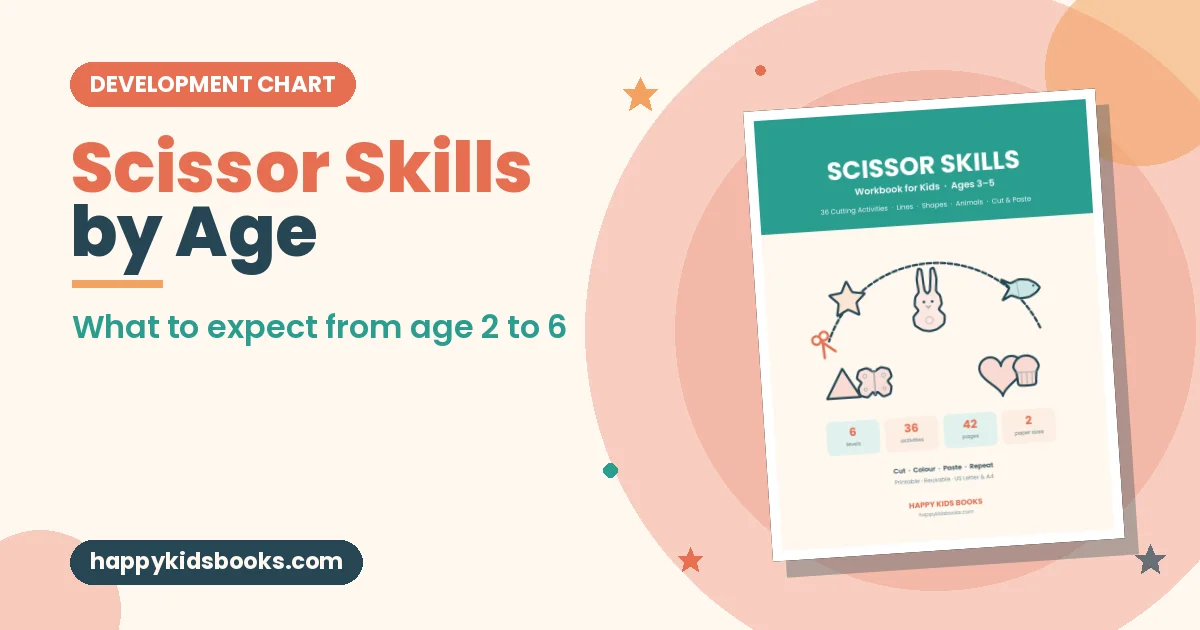
The Scissor Skills Workbook for ages 3 to 5 has 36 cutting activities in six levels: straight lines, then curves and zigzags, then shapes, ending with a whole elephant to cut out. Your child finishes with a Super Snipper certificate.
How to hold scissors correctly
- Thumbs up. The thumb goes in the small hole, pointing up toward the ceiling.
- Fingers below. The middle finger (and sometimes the ring finger) goes in the bigger hole.
- Helper hand holds the paper, also with the thumb on top.
- Elbow close to the body rather than sticking out.
For a full walkthrough of the first steps, read how to teach a 3 year old to use scissors.
Activities to build scissor skills at every age
- Before cutting: play dough, tongs, clothespins and spray bottles to build hand strength. See our fine motor activities for 3 year olds.
- Snipping: straws, play dough snakes and narrow paper strips.
- Lines: thick lines drawn with a marker, made thinner as your child improves.
- Shapes: large shapes first, then smaller ones.
When to get extra support
If your child is 5 or older and still cannot snip paper, or cutting seems very hard compared with other hand skills, mention it to your pediatrician or their teacher. An occupational therapist can check hand strength and coordination. Our fine motor skills checklist before kindergarten can help you describe what you are seeing.
Frequently asked questions
At what age can a child use scissors?
Many children can snip paper with child-safe scissors at around 2.5 to 3 years old, with close supervision. Cutting along a straight line usually comes between 3 and 4.
When should a child be able to cut a straight line?
Most children start cutting along a thick straight line between 3 and 3.5, and become more accurate by about 4.
When can kids cut out a circle?
Cutting out a circle is typical between about 4 and 5 years, once children can turn the paper with their helper hand while they cut.
What scissors are best for a 3 year old?
Small, child-safe scissors with blunt tips and blades that actually cut paper. Very cheap plastic scissors that do not cut can be more frustrating than helpful.
Is it normal for a 4 year old to struggle with cutting?
Yes, many 4 year olds are still working on straight lines and curves. Short, regular practice with easy successes usually helps more than long sessions.
The takeaway
Find your child’s current stage in the chart, practice that one skill for a few minutes a day, and move on only when it feels easy. Scissor skills grow in small steps, and every snip counts.
Get new printables in your inbox
Join other parents getting new printable pages, freebies and simple at-home learning tips. No spam, unsubscribe anytime.