
Reading comprehension activities for 3rd grade that work. 12 practical ideas for children who read fluently but can't explain what happened.
Quick answer
The most effective reading comprehension activities for 3rd grade happen before, during and after reading: predicting from the title, pausing to picture scenes and ask questions, then retelling and summarizing in their own words. First work out what is actually going wrong (vocabulary, working memory or attention), then use short, regular sessions that rotate different question types.
Your child reads aloud smoothly. The words come out fluently, the pace is good, and nothing seems to be going wrong. Then you ask what the story was about and you get a shrug, or a retelling of the one detail they happened to notice. It is one of the most common worries parents bring to teachers at this age, and it is exactly what these reading comprehension activities for 3rd grade are designed to fix.
The reassuring part: this is normal, it is well understood, and it responds quickly to the right kind of practice.
Why fluent readers sometimes understand very little
Reading is really two separate skills bolted together. The first is decoding — turning printed letters into spoken words. The second is comprehension — turning those words into meaning. A child can be excellent at the first while doing almost nothing with the second.
Around third grade this becomes visible for a specific reason. Up to this point, most school reading is designed to be decodable and the stories are simple. From third grade onwards children stop learning to read and start reading to learn, and texts get longer, less predictable and more information-dense. A child who has been coasting on strong decoding suddenly has nothing to fall back on.
Teachers sometimes call this the fourth grade slump, because that is when it usually shows up in test results. Catching it a year earlier is much easier than catching it later.
First, work out what is actually going wrong
Before trying any reading comprehension activities for 3rd grade, spend ten minutes narrowing down the problem. Ask your child to read a short passage aloud, then work through these:
- Vocabulary. Point to four or five words in the passage and ask what each means. If more than two are unknown, the issue is vocabulary rather than comprehension.
- Working memory. Ask what happened at the start of the passage. If they remember the end but not the beginning, they are losing information as they go.
- Attention. Read the same passage aloud to them and ask the same questions. If they answer well when listening but poorly when reading, decoding is using up all their mental effort.
- Engagement. Try a passage about something they love. If comprehension jumps, the problem is interest, not ability.
That last one catches more children than people expect. It is worth ruling out before assuming a skills gap.
Before reading: 3 activities
1. Predict from the title and pictures
Before opening the book, ask what they think will happen and why. This gives the brain something to check against while reading, which turns passive reading into active reading. Thirty seconds, every time.
2. Two-minute background chat
If the text is about volcanoes, spend two minutes talking about volcanoes first. Comprehension depends heavily on prior knowledge, and a child who knows nothing about the topic will struggle no matter how well they decode.
3. Pre-teach three words
Skim ahead and pick three words they probably do not know. Explain them before starting. Encountering an unknown word mid-sentence derails comprehension for the whole paragraph.
During reading: 4 activities
4. Stop and summarise
At the end of each page or section, ask for one sentence on what just happened. Keep it to one sentence — the constraint is what makes it work, because it forces them to choose the important thing over the interesting thing.
5. Sticky note questions
Give your child a few sticky notes and ask them to mark anything confusing. This does two things: it makes it acceptable to be confused, and it gives you a precise list of where comprehension broke down.
6. Make a mental movie
Every few paragraphs, ask what they are picturing. Children who struggle with comprehension often are not visualising at all — the words go in as sound and never become images. Asking about colors, faces and rooms builds the habit.
7. Track the character’s feelings
Ask how the character feels right now, and what in the text tells you that. This is inference practice, which is the hardest comprehension skill and the one most often tested.
After reading: 5 activities
8. Retell in five fingers
Hold up five fingers: characters, setting, problem, events, resolution. Your child touches each finger and gives that part. The physical structure does the organizing for them.
9. Draw the middle
Ask them to draw what happened in the middle of the story. Beginnings and endings are easy to remember; the middle is where comprehension actually lives.
10. Ask a question you cannot answer from one sentence
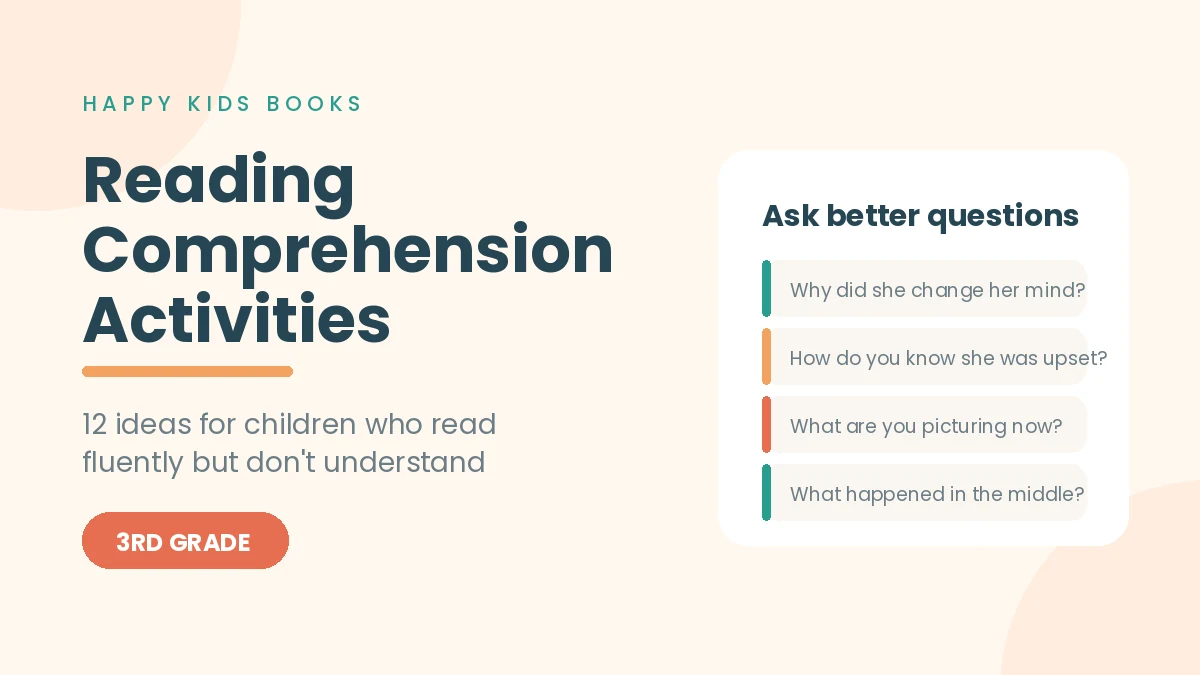
Instead of “what color was the dog”, try “why did she change her mind”. Literal questions test memory. Inference questions test comprehension.
11. Swap roles
Let your child ask you the questions. Writing a good question about a text requires understanding it, and children find this far more fun than answering.
12. Connect it to their life
Ask when something similar happened to them, or what they would have done differently. Personal connection is what makes a text stick in memory rather than sliding away.
The five question types worth rotating
Most parents ask only literal questions, because those are the easiest to think of on the spot. Teachers rotate through five types, and mixing them is what builds the skill. Whatever you are reading, try one of each:
- Literal — what happened, who was there, where were they
- Inferential — why did that happen, how do you know she was upset
- Vocabulary — what does this word mean here, what else could it mean
- Structural — what is the main idea, what happened first and last
- Evaluative — was that fair, what would you have done, do you agree
Inferential and evaluative are where most third graders need the practice, and they are also the ones parents ask least often.
Three things to avoid
Some well-meant approaches make comprehension worse.
Do not quiz after every page. Constant testing turns reading into an exam and kills the enjoyment that drives voluntary reading. Two or three questions per session is plenty.
Do not move to harder books to force improvement. A child who is struggling to comprehend needs easier text, not harder text. Comprehension improves when decoding is comfortable enough to leave mental capacity free.
Do not stop reading aloud to them. Listening comprehension runs about two years ahead of reading comprehension at this age. Reading harder books aloud builds vocabulary and story structure that their own reading will grow into.
A realistic weekly routine
You do not need to do all twelve. Pick one from each stage and rotate:
- Monday, Wednesday, Friday. Fifteen minutes of independent reading, then two questions — one literal, one inferential.
- Tuesday, Thursday. You read aloud from a harder book, they listen, and you stop twice to ask what they are picturing.
- Once a week. A short passage with written questions, so they practice the format they will meet in school assessments.
Fifteen minutes, five days a week, beats an hour at the weekend. Consistency matters more than volume with comprehension.
Ready-made passages and questions
The weekly written practice is the part most parents find hardest to source, because a good passage needs to be the right length, the right level, and come with questions that span more than just recall.
Our Grade 3–5 Language Arts Workbook covers comprehension alongside grammar, vocabulary and writing, with questions written across all five types above. If your child is still building fluency and you want shorter texts, the Decodable Passages Pack gives you 32 short stories with comprehension questions at a gentler reading level.
For younger siblings, our kindergarten readiness checklist covers the early listening and retelling skills that comprehension is built on.
Frequently asked questions
My child reads fluently but remembers nothing. Is that dyslexia?
Usually not. Dyslexia primarily affects decoding, and a fluent reader has decoding working. What you are describing is more consistent with a comprehension gap. That said, if difficulties persist despite regular practice, ask the school to look into it — specific comprehension difficulties do exist and are worth identifying.
How long before I see improvement?
Most parents notice a difference in retelling within three to four weeks of consistent practice. Inference takes longer, often a term or more, because it depends on vocabulary and background knowledge building up alongside.
Should my child read aloud or silently?
Both. Reading aloud lets you hear decoding problems, but silent reading is usually better for comprehension because it is faster and less effortful. Alternate between them.
What reading level should the books be?
For comprehension practice, choose books where your child stumbles on roughly one word in twenty or fewer. Any harder and too much effort goes into decoding.
Do audiobooks help comprehension?
Yes, more than most parents expect. Audiobooks build vocabulary, story structure and listening comprehension without the decoding load, and all three transfer to reading. They are a supplement, not a replacement.
The short version
Fluent reading and good comprehension are different skills, and third grade is when the gap becomes visible. Ask better questions rather than more questions, keep texts comfortable rather than challenging, and practice for fifteen minutes on most days. That combination closes the gap for the large majority of children.
Get new printables in your inbox
Join other parents getting new printable pages, freebies and simple at-home learning tips. No spam, unsubscribe anytime.