
25 quiet time activities for 4 year olds they can do on their own, plus how to set up a quiet time box and build up to an hour of calm play.
Quick answer
Good quiet time activities for 4 year olds are things they can do alone with little help: coloring pages, dot-to-dot puzzles, sticker scenes, picture books, simple puzzles, play dough and building blocks. Keep them in a special quiet time box, start with 20 to 30 minutes, and use a visual timer so your child knows when it ends.
Many 4 year olds drop their nap long before their parents are ready to give up the break. Quiet time is the answer: an hour of calm, independent play in their room or a cozy corner, while everyone recharges.
The trick is having the right activities ready. Here are 25 ideas that 4 year olds can do on their own, plus a simple way to set up quiet time so it actually sticks.
What is quiet time for a 4 year old?
Quiet time is a daily stretch, usually 30 to 60 minutes after lunch, when your child plays calmly by themselves. They do not have to sleep. They just stay in one place with low-energy activities. Many families switch to quiet time when naps stop between ages 3 and 5.
How long should quiet time last at age 4?
Start small. Twenty minutes is a realistic first goal, then add 5 minutes every few days until you reach 45 to 60 minutes. A visual timer or a clock with a colored light helps, because 4 year olds cannot yet judge time.
25 quiet time activities for 4 year olds
Paper and pencil activities
1. Coloring pages. The classic for a reason. Coloring is calm, needs no help and strengthens the hand. We explain why in is coloring good for toddlers.
2. Dot-to-dot puzzles. Number puzzles with 10 to 25 dots are ideal for most 4 year olds. Not sure if your child is ready? See what age kids can do dot-to-dots.
3. Simple mazes. Wide paths and a clear start and finish.
4. Tracing pages. Lines, shapes and letters to trace with a crayon.
5. Drawing prompts. A half-finished picture, like a house without a door, for your child to complete.
6. Dry-erase pages. Slip a worksheet into a plastic sleeve and give your child a dry-erase marker so they can repeat it.
Fill the quiet time box in five minutes
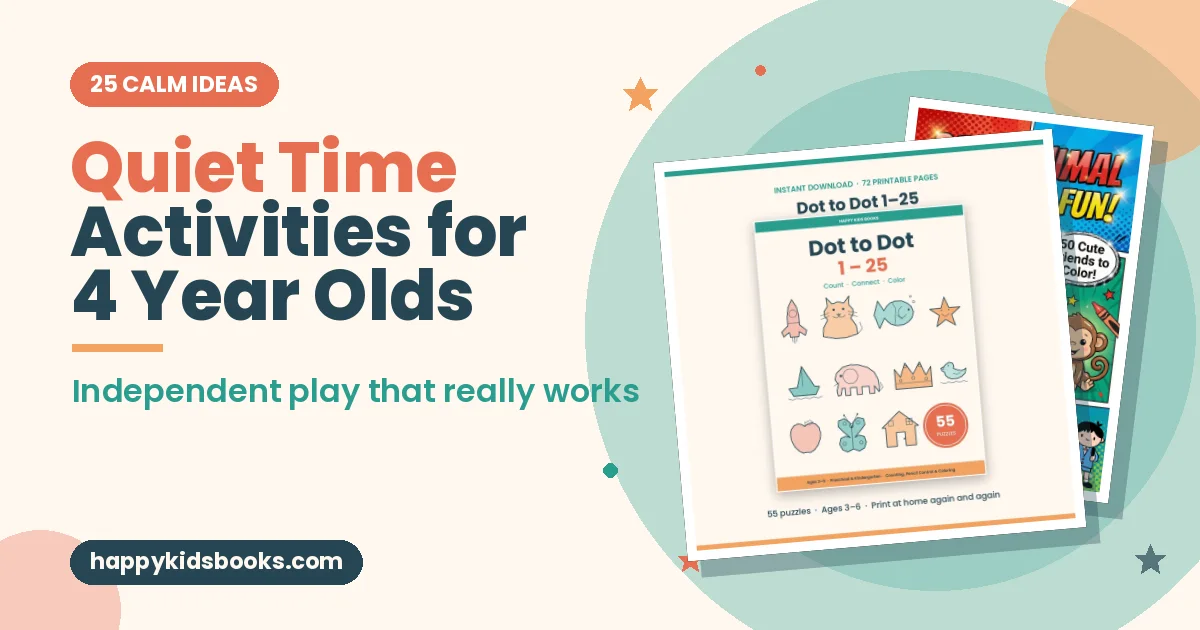
Print a few pages from our Dot to Dot 1-25 Workbook (55 puzzles that grow from 10 to 25 dots) and our Baby Animal Coloring Book (50 calm coloring pages), and quiet time is ready for weeks.
Hands-on activities
7. Play dough with tools. Rolling pin, cookie cutters and a plastic knife.
8. Sticker scenes. A blank background page and a sheet of stickers to build a story.
9. Lacing cards. Punch holes around a cardboard shape and give your child a shoelace.
10. Pipe cleaner sculptures. Twist, bend and thread beads onto them.
11. Sorting tray. A muffin tin with buttons, pom-poms or pasta shapes to sort by color or size.
12. Building blocks or magnetic tiles. Quiet building, as long as nothing gets thrown.
Thinking and puzzle activities
13. Jigsaw puzzles. 12 to 24 pieces suits most 4 year olds.
14. Pattern blocks. Copy a picture or invent a new one.
15. Matching cards. A memory game they can play alone face up.
16. I spy pages. Busy pictures with objects to find.
Reading and listening activities
17. A book basket. Rotate 6 to 8 picture books each week so there is always something new.
18. Audiobooks. A simple audio player with stories, no screen needed.
19. Photo album. Looking at family photos is surprisingly absorbing.
20. “Read” to stuffed animals. Retelling a familiar book from the pictures builds language.
Pretend play activities
21. Small world play. A tray with toy animals, a scarf for a river and some blocks.
22. Dress-up bin. Hats, scarves and old shirts.
23. Doll or figure house. Quiet storytelling with small figures.
24. Felt board. Felt shapes stick to a felt square and can be rearranged again and again.
25. Fort reading nook. A blanket over two chairs, a flashlight and a few books.
How to set up a quiet time box
- Pick 4 to 6 activities from the list above.
- Put them in a box or bin that only comes out at quiet time. Special equals interesting.
- Rotate the contents weekly so your child does not get bored.
- Use a visual timer and explain that quiet time ends when the timer does.
- Keep the same time every day. Right after lunch works well for most families.
| Week | Quiet time length | What to add |
|---|---|---|
| Week 1 | 20 minutes | Coloring pages, books, blocks |
| Week 2 | 30 minutes | Dot-to-dot puzzles, sticker scenes |
| Week 3 | 45 minutes | Play dough, lacing cards, puzzles |
| Week 4 | 45 to 60 minutes | Rotate in new pages and books |
Looking for more ideas that do not involve a tablet? Our big list of screen-free activities for kids has plenty more, and our car and restaurant activity guide covers quiet time on the go.
Frequently asked questions
What are good quiet time activities for a 4 year old?
Coloring pages, dot-to-dot puzzles, picture books, play dough, sticker scenes, jigsaw puzzles and building blocks all work well. The best ones can be done alone, without much noise or help.
How long should quiet time be for a 4 year old?
Start with about 20 minutes and build up to 45 to 60 minutes over a few weeks. A visual timer helps your child understand when quiet time will end.
What do I do if my 4 year old will not stay in quiet time?
Shorten the time, make the activity box more appealing and stay consistent with the same time each day. Praise the minutes they do manage and slowly add more.
Is quiet time a good replacement for a nap?
For many children who have stopped napping, yes. Quiet time gives them a rest from activity and gives parents a break. If your child often falls asleep during quiet time, they may still need a nap.
Should quiet time include screens?
It works best without screens. Hands-on activities, books and printables keep the time calm and help children practice playing on their own.
Try it tomorrow
Fill a box with a few coloring pages, two dot-to-dots, a picture book and some play dough. Set a timer for 20 minutes after lunch. That is all it takes to start a habit you will both look forward to.
Get new printables in your inbox
Join other parents getting new printable pages, freebies and simple at-home learning tips. No spam, unsubscribe anytime.