
Most screen-free activity lists fail because they ignore whether an activity holds attention. Here is what actually works, sorted by how much of you it needs.
Quick answer
Screen-free activities hold kids’ attention when they match your child’s skill level and need little help from you. For example, coloring pages with bold, simple outlines keep toddlers busy far longer than detailed ones. Keep a small rotating set of activities ready, and build a predictable daily quiet time so the habit sticks.
Every list of screen-free activities for kids has the same problem. It suggests a sensory bin, your child plays with it for four minutes, and then you are back where you started — except now there is rice on the floor.
The issue is not the activities themselves. It is that most lists ignore the only thing that matters to a tired parent: will this hold their attention without me sitting there the whole time?
So here is a different approach. First, what actually makes an activity stick. Then the screen-free activities for kids that genuinely work, sorted by how much of you each one requires.
Why most screen-free activities for kids fail
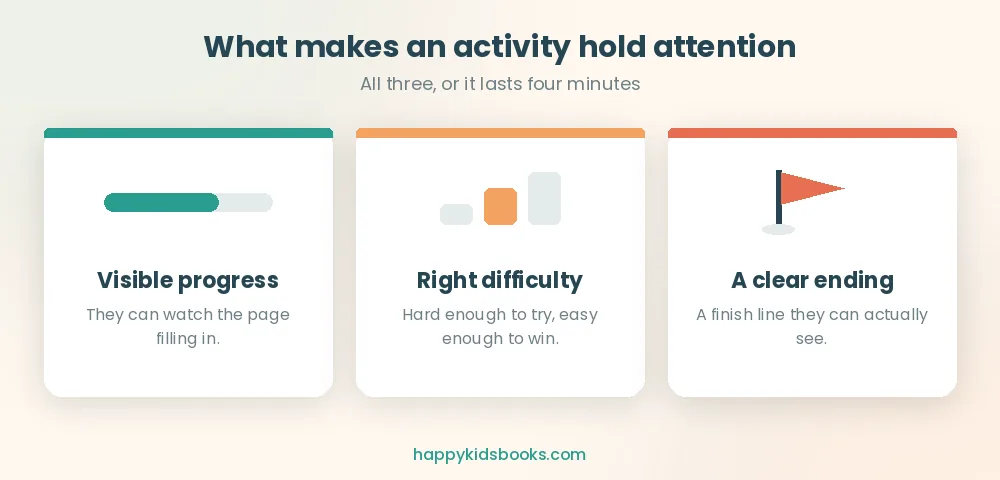
Three things separate the activities that last forty minutes from the ones that last four.
Visible progress. Children stay with tasks where they can see they are getting somewhere. A coloring page slowly filling in has this. An open-ended bin of toys does not. This is also, incidentally, why screens are so effective — they deliver constant feedback.
The right level of difficulty. Too easy is boring. Too hard means being called back every thirty seconds. What you want is visible effort followed by success.
A clear ending. “Play with these blocks” has no finish line. “Finish this page” does. Children work harder when they can see where a task ends.
Judge any activity against those three and you can predict roughly how long it will hold before you even try it.
Screen-free activities for kids that need nothing from you
This is the category parents actually need. Not bonding time — twenty minutes to make dinner.
Coloring, if the pages match their control. This is where most parents go wrong. Give a three-year-old a detailed page and they abandon it in two minutes. Give them bold, simple outlines with large open areas and they will keep going far longer. The page has to match the hand.
Best for independent quiet time
Printable Baby Animal Coloring Book for Kids | 50 Toddler Coloring Pages PDF
50 baby animal pages with thick outlines and large open areas, sized for toddler grip and crayon control. Print a few at a time and keep a stack in the kitchen drawer for the moments you need them.
$4.90 instant download
Dot-to-dots. These score well on all three criteria — visible progress, a clear ending, and a reveal at the finish. They also fold in counting practice without it feeling like schoolwork, which is why they hold attention better than counting worksheets.
Best for a clear finish line
Dot to Dot 1-25 Printable Workbook | 55 Connect the Dots Puzzles for Kids Ages 3-6
55 connect-the-dots puzzles running 1 to 25. The picture appearing at the end is the reason children keep going, and the counting practice comes along for free.
$6.99 instant download
Cutting practice. Surprisingly absorbing for preschoolers, and it builds genuine hand strength. Supervise with scissors, obviously, but most four-year-olds will work through several pages independently once shown how.
Sticker books and sorting tasks. Sorting buttons by color, matching socks, threading dried pasta onto string. Dull to adults, deeply satisfying to a four-year-old.
An audiobook with something to do. Audio on its own rarely holds young children. Audio combined with coloring often holds them for a full chapter, because the hands stay busy while the story runs.
A shoebox of loose parts. Bottle caps, ribbon, corks, fabric scraps. Rotate the contents every few weeks so it feels new again.
Activities that need a bit of you
Baking anything. Measuring, pouring, waiting. Covers math, sequencing, and patience, and produces food at the end.
Indoor obstacle courses. Cushions, chairs, masking tape on the floor. Set it up once and most children will run it twenty times.
Drawing together, badly. Take turns adding to a single picture. The only rule is that nobody is allowed to say theirs is bad.
Reading aloud above their level. A child’s listening comprehension runs years ahead of their reading ability. This is where vocabulary actually grows, and it costs you nothing but time on the sofa.
Screen-free activities for kids outside the house
A walk with a job. “Find five red things” beats “let’s go for a walk” by a wide margin. Give the walk a task and it stops being a negotiation.
Puddles, sticks, and dirt. Unglamorous, free, and consistently effective.
A printed activity folder in the car. Possibly the single most useful thing to keep in the glovebox. Restaurant delays, waiting rooms, long journeys, appointments that overrun.
Best all-in-one for the car
Little Learner Kindergarten Readiness Workbook | Ages 3–6
Letters, numbers, shapes, and early writing in one workbook covering ages 3 to 6. Print a folder full and keep it in the car for the moments you need twenty quiet minutes.
$4.90 instant download
When none of it is working
Some days nothing lands, and that is usually not about the activity.
A tired, hungry, or overstimulated child cannot settle to anything, and hunting for a better craft idea will not fix it. Food, quiet, and lower expectations will.
It is also worth saying plainly: screens are not the enemy. The American Academy of Pediatrics updated its guidance in 2026 to focus less on rigid time limits and more on the quality of what children watch and the conversations families have about it. A tired parent putting something on so they can function is making a reasonable decision. The goal is having good alternatives available, not eliminating screens altogether.
Frequently asked questions
How long should a young child play independently?
It varies a lot, but a 3-year-old may manage around 5 to 10 minutes alone, and the time grows with age. Activities matched to your child’s skill level hold attention much longer.
What are good screen-free activities for toddlers to do alone?
Coloring pages with bold outlines, stickers, simple puzzles, play dough and dot-to-dots with only a few dots are all easy for toddlers to do on their own.
How do I stop my child constantly asking for screens?
Predictable routines help most. When quiet time happens at the same time each day with the same small set of activities, children tend to argue less.
Are printable workbooks a good screen-free activity?
Yes, when the pages match your child’s level. Short pages with tracing, cutting or coloring make easy independent activities.
Building a routine that lasts
The families who manage this well are not more disciplined. They are just better prepared.
Keep a folder of printed pages somewhere easy to reach. Coloring for the youngest, dot-to-dots and cutting for four and up, mixed activity pages for the car. When the moment arrives, you are reaching for a folder rather than searching the internet with a child pulling at your sleeve.
Printables suit this particularly well for two reasons. You can reprint a page that becomes a favorite, and you print only what matches your child’s stage rather than paying for a whole book of pages they are not ready for. If you are weighing that against buying workbooks in a shop, our honest comparison of printable and store-bought covers the trade-offs, and our guide to choosing a workbook by age will point you to a sensible starting place.
Match the activity to what your child can already almost do, keep it within reach, and most screen-free activities for kids will hold far longer than you expect.
Get new printables in your inbox
Join other parents getting new printable pages, freebies and simple at-home learning tips. No spam, unsubscribe anytime.