
A stage-by-stage guide to choosing printable workbooks for ages 3 to 9, with what each age is working on and which workbook fits.
Quick answer
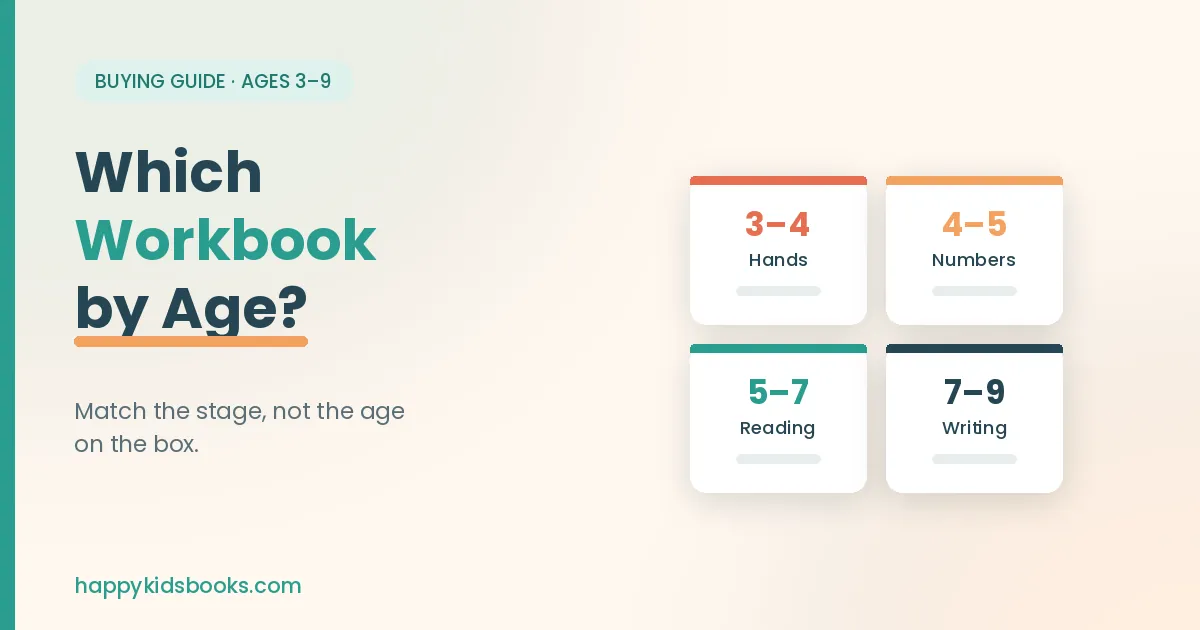
Choose printable workbooks by stage, not just subject. Ages 3 to 4 need hand skills first (cutting, tracing and coloring). Ages 4 to 5 add numbers, pencil control and school readiness. Ages 5 to 7 focus on reading: phonics, sight words and decodable text. Ages 7 to 9 move on to comprehension and writing well.
The most common mistake parents make with printable workbooks isn’t buying the wrong subject. It’s buying the right subject at the wrong stage.
A cutting workbook aimed at a four-year-old will frustrate a two-year-old and bore a six-year-old. Sight word practice given too early feels like memorizing nonsense. The content can be excellent and still be a waste of five dollars if the timing is off.
So here’s a straight guide by age, with what each stage is actually working on, and which workbook fits. If you’re still deciding whether printables suit your family at all, read our printable vs store-bought comparison first.
Ages 3–4: hands before letters
At three, the useful work is almost entirely physical. Grip strength, hand separation, bilateral coordination — holding paper with one hand while the other does something different. Letters can wait.
Parents often skip straight to alphabet tracing here, and it usually backfires. A child whose hand tires after thirty seconds isn’t going to enjoy forming letters. Build the hand first.
Best for cutting practice
Scissor Skills Workbook for Kids Ages 3-5 | Printable Cutting Practice PDF
Progressive cutting practice starting with straight lines and building to curves and shapes. The reprintable format matters here — children usually need the same page several times before control clicks.
Skip it if: your child cannot yet hold scissors with a thumb-up grip, or shows no interest in them at all.
$7.99$6.99
Best for quiet time
Printable Baby Animal Coloring Book for Kids | 50 Toddler Coloring Pages PDF
50 baby animal pages with bold, simple outlines suited to toddler grip. Large shapes and thick lines mean less frustration than detailed adult-style coloring books.
Skip it if: your child is already coloring inside fine detail comfortably — they will find these too simple.
$4.90
Ages 4–5: numbers, control, and getting ready
This is the year pencil control becomes reliable and number sense arrives. Children start counting with meaning rather than reciting, and can follow a two-step instruction.
It’s also the stage where kindergarten readiness starts to matter to parents. Our kindergarten readiness checklist is the honest version of what schools actually expect — it’s less than most parents fear.
Best for number confidence
Dot to Dot 1-25 Printable Workbook | 55 Connect the Dots Puzzles for Kids Ages 3-6
55 connect-the-dots puzzles running 1–25. Combines counting sequence with pencil control, and the reveal at the end gives a reason to finish. More motivating than counting drills.
Skip it if: your child cannot yet count reliably to 10 — start there first.
$6.99
Best all-rounder before school
Little Learner Kindergarten Readiness Workbook | Ages 3–6
Covers letters, numbers, shapes, and early writing in one place. The broadest option here, useful when you want general readiness rather than one specific skill.
Skip it if: you already know the exact gap you are targeting — a focused workbook will serve you better.
$4.90
Ages 5–7: reading takes over
Once a child knows most letter sounds, everything shifts toward blending and reading actual text. This is where the right material matters most, because reading practice done badly builds guessing habits that take a long time to undo.
Two things run in parallel at this stage: decoding practice, and the small set of high-frequency words that genuinely need to be recognized on sight. Our guide to sight words vs phonics explains why you need both rather than choosing.
Best for reading practice
Decodable Passages Printable | Phonics Pack Grades K-2
32 stories across 85 pages, sequenced so each one uses only the phonics patterns introduced before it. Nothing your child has not been taught, which means no guessing from pictures.
Skip it if: your child is not yet blending simple three-sound words — work on letter sounds first.
$4.99
Best for high-frequency words
Safari Sight Words Workbook for Kids Ages 5–9
Safari-themed practice covering the words that appear constantly in early texts and cannot always be sounded out. Designed to sit alongside phonics work, not replace it.
Skip it if: your child already reads simple sentences fluently — move to comprehension work.
$4.99
Ages 7–9: from reading to writing well
By this point decoding is mostly automatic and attention turns to comprehension, grammar, and writing with structure. The work gets less about mechanics and more about expression.
Best for older children
Grade 3–5 Language Arts Workbook PDF – Printable English Worksheets
Grammar, vocabulary, and writing practice pitched at grades 3–5. Useful for holiday practice or shoring up a specific weak area rather than broad revision.
Skip it if: your child is still working on fluent reading — comprehension work will frustrate them.
$4.99
If you are not sure which stage your child is at
Age on the box is a rough guide, nothing more. Two five-year-olds can be eighteen months apart in fine motor control and both be entirely normal.
A better test: give your child a page and watch the first two minutes. If they need help on nearly every item, it is too hard. If they finish without pausing, it is too easy. You want visible effort followed by success — that is the productive zone.
Our fine motor skills checklist is a useful way to place a preschooler more precisely than age alone.
Before you print
Two settings account for most printing disappointment:
Print at 100%, not “fit to page.” Scaling shrinks letter sizing and throws off handwriting guides. Look for “Actual size” in your print dialog.
Check paper size. US Letter and A4 have different proportions. Where a workbook offers both, pick the one your printer is loaded with.
Draft mode is fine for practice pages. Save the good ink for anything going on the fridge.
Frequently asked questions
What workbook should a 3-year-old use?
Start with hand skills: coloring, simple tracing lines and cutting practice with child-safe scissors. Letters can wait until the hands are ready.
When should kids start sight word workbooks?
Usually around ages 5 to 6, once your child knows most letter sounds and has started blending simple words.
What if my child is between two stages?
Choose the easier level. A workbook that feels easy builds confidence and you can move up quickly, while one that feels too hard often gets abandoned.
How many workbook pages should my child do a day?
For ages 3 to 6, one to three pages or about 10 to 15 minutes is plenty. Older children can do a little more.
The short version
Ages 3–4, build the hand. Ages 4–5, add numbers and general readiness. Ages 5–7, reading becomes the priority. Ages 7–9, comprehension and writing.
Buy one thing that matches where your child is right now, rather than a bundle covering three years. You will find out quickly whether the format works for your family, and five dollars is a cheap way to learn that.
Get new printables in your inbox
Join other parents getting new printable pages, freebies and simple at-home learning tips. No spam, unsubscribe anytime.