
description Sight words and phonics aren't rivals — but most kids are taught them the wrong way round. Here's which words to memorize, which to sound out, and how to teach both.
Your child’s school sends home a list of twenty words to memorize. Meanwhile a reading expert on Instagram says memorizing words is exactly what you shouldn’t do.
Both are partly right, and the confusion costs families months of wasted practice.
Here’s what sight words actually are, why the usual flashcard approach is inefficient, and how to teach them so they support your child’s phonics instead of competing with it.
The Short Answer
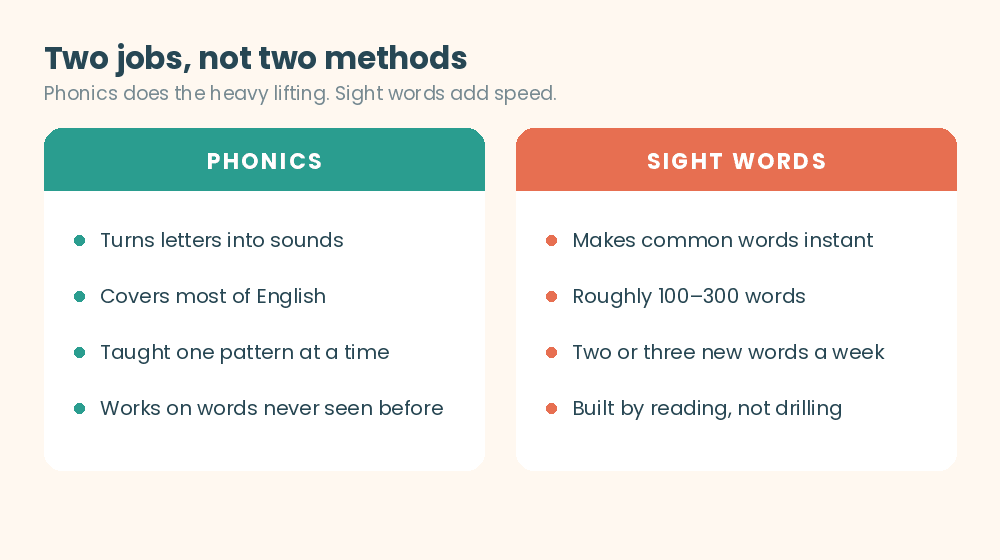
Phonics teaches your child to turn letters into sounds and blend them into words. It covers the overwhelming majority of English — most estimates put it well above 80% of words as fully or largely decodable.
Sight words are high-frequency words a child should recognize instantly. Not because they’re impossible to decode, but because they appear so often that stopping to sound them out slows reading to a crawl.
The mistake is treating those as two competing methods. They’re not. Phonics is the engine. Sight word practice is how a small number of very common words get moved from “sounded out” to “instant.”
And here’s the part most parents never hear: the fastest way to make a word instant is to decode it correctly several times. Which means sight word teaching should use phonics, not replace it.
Sight Words vs Phonics: Side by Side
| Phonics | Sight words | |
|---|---|---|
| What it teaches | Letter-sound patterns and blending | Instant recognition of common words |
| Covers | The large majority of English words | Roughly 100–300 high-frequency words |
| How it’s learned | Explicit instruction, then practice in text | Repeated correct reading, plus targeted work on irregular parts |
| When to start | As soon as your child knows a few letter sounds | Alongside phonics, a few words at a time |
| Best practice | Sequenced, one pattern at a time | Decode the regular part, flag only the odd part |
| What goes wrong | Taught too slowly, or abandoned for guessing | Taught as whole-word memorization with no letter analysis |
Why Flashcard Memorization Backfires
Hand a child the word said on a flashcard and tell them to memorize the shape, and you’ve taught them one word by a method that doesn’t scale.
Whole-word memorization has a hard ceiling. Nobody memorizes 30,000 word shapes. Children who lean on it plateau, usually somewhere in second or third grade, because the strategy that got them through cat and said does nothing for particular or entertainment.
Worse, it teaches the wrong habit. A child trained to recognize whole shapes learns to glance at a word and guess from its outline and first letter. That habit then follows them into every unfamiliar word they meet.
The Better Way: Decode Most of It, Flag the Rest
Look closely at the words on a typical kindergarten sight word list. Most are far more decodable than they appear.
- and, up, it, can, him, stop — completely regular. Your child can sound these out today. They don’t need memorizing at all; they just need practice until they’re fast.
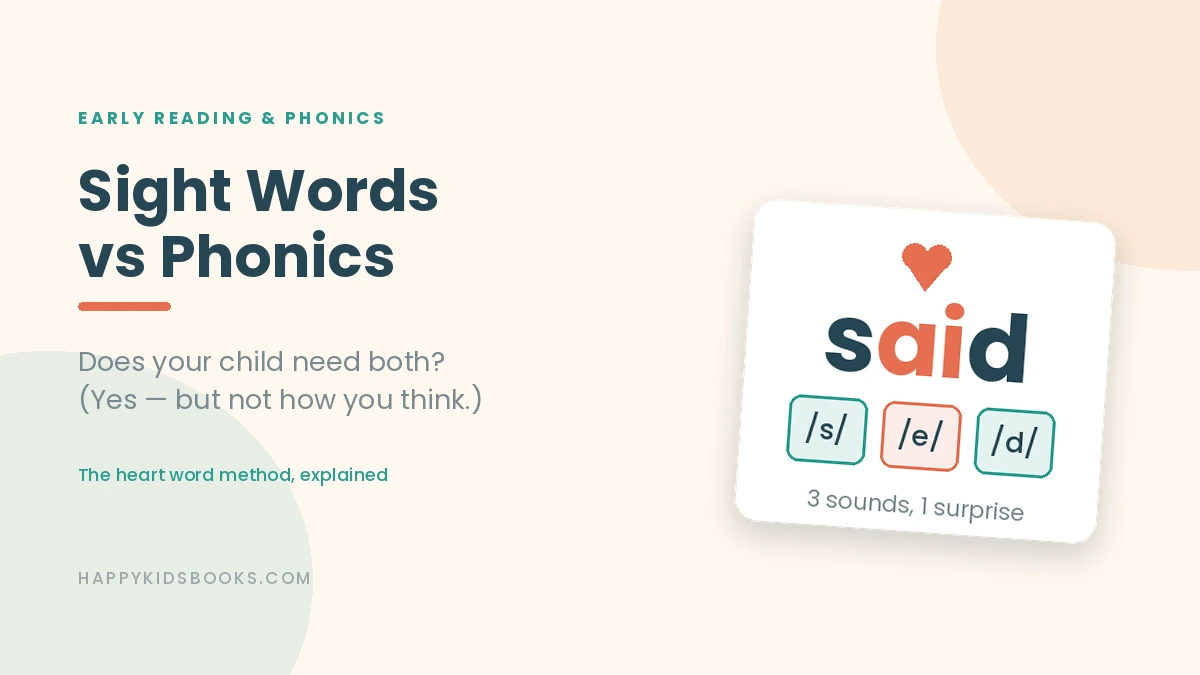
- said — the s and d are regular. Only the ai is odd.
- was — the w and s are regular. Only the a is odd.
- the — the th is regular. Only the e is odd.
So instead of memorizing the whole word, you sound out the parts that behave and mark only the part that doesn’t. Many teachers draw a small heart above the irregular letter and call these heart words — the heart marks the bit you have to learn “by heart.”
This works better for a simple reason: your child is still looking at every letter. You’re not asking them to stop decoding. You’re telling them which single letter is being unusual, which is a much smaller thing to remember than a whole word shape.
How to Teach a Sight Word in Two Minutes
Take said as the example.
1. Say it and use it. “Said. She said hello. Say it back to me.”
2. Count the sounds. said has three: /s/ /e/ /d/. Hold up three fingers.
3. Map sounds to letters. Write it out with your child. The /s/ is s, the /d/ is d — both expected. The middle sound /e/ is spelled ai, which is the surprise.
4. Mark the odd part. Draw a small heart above the ai. “This bit we learn by heart. Everything else works normally.”
5. Read it in a sentence. Not on a card, in a real sentence. Then find it in a book.
Two or three words a week is plenty. Ten new words on Monday is how families end up with a child who knows none of them by Friday.
Where the Words Should Actually Be Practiced
Cards on the fridge do very little on their own. Words become instant through being read in running text, correctly, over and over.
This is exactly what decodable passages give you — controlled text where the phonics is manageable and two or three high-frequency words appear repeatedly across a story. Your child meets said eight times in one sitting, in context, decoding it right each time. That’s what makes it stick.
If you’re not sure whether your child’s reading books are helping or letting them guess, decodable vs leveled readers covers the difference and how to tell them apart.
Stories your child can actually read
Our Decodable Passages Pack has short illustrated stories with comprehension questions, sequenced from simple CVC words up. Grades K to 2, instant PDF download.
Which Sight Words Should You Teach First?
Start with the words your child is actually going to meet in the next few weeks, not with the top of an alphabetical list.
The practical order:
- The tiny connectors — the, a, is, to, of, and, was, said, you, they. These appear in nearly every sentence. Nothing your child reads will work without them.
- Words in the books on your shelf. Open the book you’re about to read. Any high-frequency word in it beats any word on a generic list.
- Regular words for speed, not memory. can, had, get, him, stop. Don’t teach these as sight words at all. Let phonics handle them and let repetition make them fast.
You’ll see the Dolch and Fry lists recommended everywhere, and they’re perfectly good source material. Just don’t work through them front to back at ten words a week — that’s a schedule, not a plan.
If you want the sequencing handled for you, the Safari Sight Words Workbook works through the core list with tracing, matching, and sentence practice, so each word gets read in context rather than drilled in isolation.
Four Mistakes to Avoid
Teaching too many at once. Two or three a week, mastered, beats ten a week, half-learned.
Skipping the sounds. If you show the word and say “this one you just have to know,” you’ve taught memorization. Take the extra thirty seconds to identify which part is actually irregular.
Drilling cards instead of reading text. Cards check what’s known. Text is what builds it.
Dropping words once they’re “learned.” A word learned in October needs to reappear in December. Keep old words in rotation — reread old passages, revisit old books.
Does Any of This Change for Older Children?
If your child is seven or eight and still stalling on common words, the same approach applies, just faster. Check whether the words they’re stuck on are genuinely irregular or simply unpracticed. Nine times out of ten it’s the second, and the fix is more reading of manageable text rather than more flashcards.
For children still building the foundations — letter sounds, blending, tracking left to right — start there instead. The kindergarten readiness checklist covers what to look for, and the Little Learner Activity Book has hands-on letter and sound work for ages 3–6.
Frequently asked questions
Should I teach sight words or phonics first?
Start with phonics (letter sounds and blending) and add a small number of very common sight words alongside it. Knowing letter sounds makes sight words much easier to learn.
What are heart words?
Heart words are high-frequency words with a tricky part that does not follow the phonics your child knows yet. Children sound out the regular parts and learn the tricky part by heart.
Are sight word flashcards bad?
Not bad, but memorizing words as whole shapes is slow. Words stick faster when children decode them correctly several times and then read them in real sentences.
How many sight words should a kindergartner know?
Many kindergartners know somewhere around 20 to 50 common words, but the range is wide. Steady progress matters more than hitting a specific number.
Get new printables in your inbox
Join other parents getting new printable pages, freebies and simple at-home learning tips. No spam, unsubscribe anytime.