
What 3rd grade language arts actually covers, the four skills worth practicing at home, and how to tell which worksheets are worth printing.
Third grade is the year the ground shifts. Up until now school has been about learning to read. From third grade on, reading is the thing your child does in order to learn everything else. Science, social studies, even word problems in math all start arriving as paragraphs.
That’s why parents start searching for 3rd grade language arts worksheets around this time of year. Something feels like it stepped up, and it did.
The trouble is that “language arts” is a bucket with about six different things in it, and worksheet packs online tend to grab whatever’s cheapest to produce. Below is what third grade language arts actually covers in US classrooms, which parts are worth your time at home, and roughly how much practice is enough.
What 3rd grade language arts actually covers
Most US districts organize it into five strands. Your child’s report card probably uses some version of these labels.
- Reading: literature. Stories, fables, and poems. Character motivation, how a story’s parts fit together, and answering questions using evidence from the text rather than a guess.
- Reading: informational text. Articles and nonfiction. Main idea and supporting details, cause and effect, using headings and captions.
- Foundational skills. Still phonics, but grown up: multisyllabic words, prefixes and suffixes, and reading aloud smoothly enough that meaning survives the trip.
- Language. Parts of speech, plurals and irregular verbs, comparatives, commas, quotation marks, possessives, and building sentences that are more than five words long.
- Writing. Three kinds: opinion, informative, and narrative. Paragraphs with a topic sentence, some supporting detail, and a closing.
That’s a wide spread. You do not need to cover all of it at home, and trying to is how families end up dreading the kitchen table.
The four things actually worth practicing at home
If you only have fifteen minutes a few times a week, spend it here.
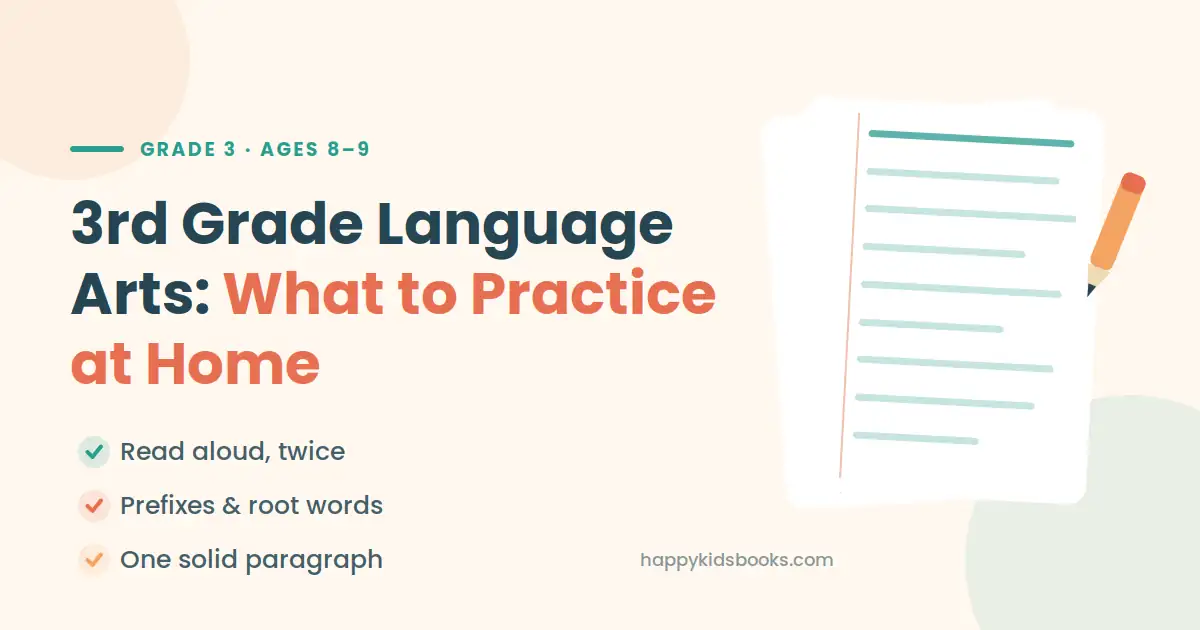
1. Reading fluency out loud
This is the highest-leverage thing on the list and almost nobody does it, because by third grade kids read silently and parents stop listening.
Fluency isn’t speed for its own sake. It’s whether your child reads smoothly enough that their brain has capacity left over to think about what the words mean. A child grinding through every sentence has no attention left for comprehension, which is why comprehension problems in third grade are so often fluency problems in disguise.
What to do: have your child read a short passage aloud, roughly a hundred words. Then have them read the same passage again. The second read is almost always noticeably better, and that improvement is the practice working. Two or three minutes, a few times a week.
Widely used benchmarks put a typical third grader somewhere around 110 words correct per minute by spring, but treat that as a rough reference rather than a target to chase. Smooth and expressive beats fast and flat every time.
2. Prefixes, suffixes, and root words
Third grade vocabulary gets too big to memorize word by word. The way through is teaching the parts.
A child who knows that un- means not, re- means again, and -less means without can decode hundreds of unfamiliar words without help. This is the single best return on vocabulary time at this age.
What to do: pick one affix a week. Find it in the wild — on cereal boxes, road signs, whatever book they’re reading. Ten seconds of noticing beats a worksheet of twenty.
3. Writing one solid paragraph
Not essays. One paragraph: a topic sentence, two or three details, a closing line.
Third graders are usually asked to jump to multi-paragraph writing before the single paragraph is solid, and the result is a page of loosely related sentences. Getting one paragraph right transfers to everything else.
What to do: give a prompt they have an opinion about. “Should kids get homework?” produces better writing than “describe your weekend,” because there’s something to argue.
4. Commas, quotation marks, and apostrophes
These three account for most of the red marks on third grade work. Quotation marks around dialogue, commas in a list and in a date, and apostrophes for possession rather than for every word ending in s.
What to do: don’t drill them. Have your child write a three-line conversation between two characters. Every rule shows up naturally and they’ll actually care whether it’s right.
How much practice is realistic
Ten to fifteen minutes, three or four times a week. That’s it.
Longer sessions look more serious and work less well. A tired third grader at minute twenty-five is not learning; they’re enduring. Short and frequent beats long and occasional by a wide margin, and it’s far more likely to survive past the second week.
A workable weeknight shape:
- Minutes 1-3. Read a short passage aloud. Read it again.
- Minutes 4-8. One skill page — grammar, vocabulary, or comprehension. One page, not five.
- Minutes 9-12. Write two or three sentences responding to what they read.
Skip a day when the day is already full. Consistency across a month matters more than any single session.
What not to worry about
Messy handwriting. Third grade is when writing volume increases sharply and neatness usually dips. It’s typically a stamina issue rather than a skill issue. We went through the causes in more detail in our post on why handwriting gets messy.
Spelling every word correctly in a first draft. Spelling and composing compete for the same attention. Let the first draft be rough and fix spelling on the second pass.
Reading level labels. A letter or number from a classroom system is a rough sorting tool, not a diagnosis. A child who reads slightly below a label but understands and enjoys what they read is in better shape than one who decodes above it and remembers nothing.
Signs worth paying closer attention to
Most third grade wobbles are normal. These are the ones worth raising with the teacher:
- Still sounding out short, common words letter by letter
- Reads a page accurately but can’t say anything about what happened
- Avoids reading aloud to the point of visible distress
- Writing is a single run-on sentence no matter the prompt
- A noticeable gap between what they can explain out loud and what lands on paper
None of these mean something is wrong. They mean it’s worth a conversation rather than another month of waiting.
Choosing worksheets that are actually worth printing
Most free third grade worksheet packs are word searches and coloring pages with a grade label on top. A few things to check before you print:
- Does it ask for text evidence? Good comprehension questions require pointing at a sentence, not recalling a fact.
- Is there writing space, not just bubbles? Multiple choice is easy to grade and teaches very little at this age.
- Does it build across pages? Random topics page to page means no skill gets consolidated.
- Is it printable in black and white? A pack that eats a color cartridge is a pack you’ll use twice.
Our Grade 3-5 Language Arts Workbook is built around the four priorities above — fluency passages, affix and root work, guided paragraph writing, and punctuation in context — sequenced so each section builds on the last rather than jumping around. It’s an instant PDF download and prints clean in black and white.
If you’re weighing printables against a store-bought workbook, we compared the two in are printable workbooks worth it.
Common questions
How many worksheets a week is right for a third grader?
Three or four single pages, one per session. A page a day that gets full attention beats a packet on Sunday that gets rushed.
My child is in 3rd grade but reading below level. Should I use 2nd grade material?
Use easier material for fluency practice and grade-level material for listening and discussion. Reading aloud to them at their actual grade level keeps vocabulary and ideas growing while decoding catches up.
Is cursive still part of third grade language arts?
It depends entirely on the state and district. Some require it in third grade, many don’t teach it at all. Ask the teacher rather than assuming either way.
What if my child refuses to do any of it?
Shorten it before you push it. Five minutes that happens is worth more than twenty that turns into a standoff. Refusal at this age is usually about difficulty or fatigue rather than attitude.
The short version
Third grade language arts is broad, but the part that moves the needle at home is narrow: read aloud briefly and often, teach word parts rather than word lists, get one paragraph solid, and let punctuation come through real writing.
Fifteen minutes, a few nights a week, kept up for a couple of months. That’s the whole thing.
Not sure what level to start at? Our guide to printable workbooks by age maps skills to ages 3 through 9.