

Messy handwriting is rarely about effort. It is usually hand strength, grip, or letter formation. Here is what causes it and what actually helps.
Quick answer
Messy handwriting is rarely about effort. The most common causes are weak hand muscles, an inefficient pencil grip and letters that were never formed the right way. What helps is building hand strength, adjusting the grip and practicing correct letter formation in short sessions, rather than simply writing more. If it does not improve with steady practice, ask about an occupational therapy assessment.
You look at your child’s homework and the letters are all different sizes, wandering above and below the line, some backwards. Messy handwriting is one of the most common worries parents bring up, and it is almost always treated as a practice problem — write more, write neater, try harder.
That advice usually fails, because messy handwriting is rarely about effort. It is about what is happening underneath: hand strength, grip, letter formation habits, and speed. Fix the cause and the neatness follows. Drill the symptom and you get a frustrated child who hates writing.
Here is what is actually going on, and what helps.
First, is it actually a problem?
Not all untidy writing needs fixing. Handwriting develops gradually, and children move toward a mature pencil grip somewhere between four and seven years old. Before that, wobbly letters are normal rather than a warning sign.
The useful question is not “is it neat?” but “is it working?” If your child writes legibly, keeps up with the class, and does not complain of a sore hand, an unusual-looking grip is not automatically something to correct. Different is not the same as wrong.
The real causes of messy handwriting
Weak hands. This is the most common cause and the most overlooked. Forming letters requires the small muscles of the hand to work independently and keep working for several minutes. A child whose hand tires after thirty seconds cannot produce neat writing no matter how hard they concentrate. The writing degrades down the page — that pattern is the giveaway.
An inefficient grip. The efficient grip holds the pencil between the thumb and index finger, resting on the middle finger. Grips that involve the whole fist or a tucked thumb work, but they tire the hand faster and give less fine control.
Letter formation habits. Many children build letters from the bottom up or in the wrong stroke order. It looks acceptable at first but falls apart as speed increases, because the strokes do not flow into each other.
Writing too fast. Some children have perfectly good control and simply race. You can spot this easily — ask them to write one sentence as slowly and carefully as possible. If that sentence is neat, the skill is there and it is a speed problem, not a motor one.
Posture and paper position. Feet dangling, table too high, paper straight in front rather than angled. Boring causes, real effects.
What actually helps
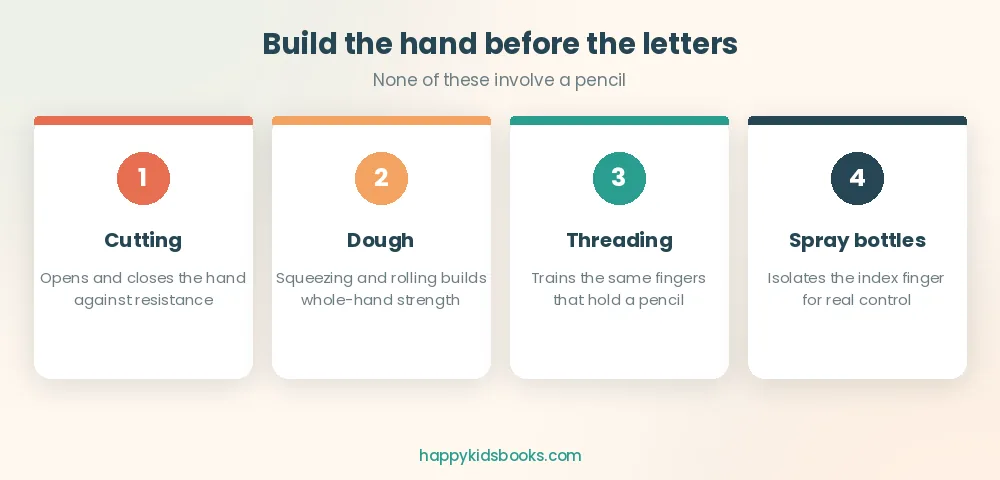
Build hand strength away from pencils. This is the highest-value thing you can do for a young child, and none of it involves handwriting practice. Cutting with scissors, squeezing spray bottles, playing with dough, threading beads, tearing paper. Cutting is particularly effective because it forces the hand to open and close repeatedly against resistance.
Best for building hand strength
Scissor Skills Workbook for Kids Ages 3-5 | Printable Cutting Practice PDF
Progressive cutting practice for ages 3 to 5, moving from straight lines to curves and shapes. Cutting builds the same hand muscles handwriting depends on, without a pencil in sight.
$7.99$6.99 instant download
Use shorter pencils and broken crayons. A small stub physically cannot be held in a fist, so it nudges the fingers into a better position without you correcting anything. Pediatric occupational therapists at Lurie Children’s Hospital recommend exactly this, along with checking that letters are being formed correctly rather than just looking correct once finished.
Watch them write, do not just look at the result. This is the single most useful diagnostic thing a parent can do. A letter that looks fine on the page may have been built in three separate strokes starting from the bottom. You cannot see that in the finished work, only while it happens.
Fix formation before neatness. Get the stroke order right first, even if it looks worse initially. Correct strokes at a slow speed will tidy up on their own. Neat letters built the wrong way will collapse the moment writing speeds up.
Work in short bursts. Five focused minutes beats twenty minutes of deteriorating effort. Stop while the writing is still good.
Check the setup. Feet flat, table at elbow height, paper tilted slightly toward the writing hand.
Best for letter formation practice
Little Learner Kindergarten Readiness Workbook | Ages 3–6
Letters, numbers, shapes and early writing for ages 3 to 6. Reprint the specific letters your child reverses rather than working through an entire book of letters they already have.
$4.90 instant download
What does not help
Making them rewrite it. Rewriting a page of messy handwriting produces a second page of messy handwriting and a child who now dislikes writing. If the underlying skill is not there, repetition just reinforces the frustration.
Comparing them to a sibling. Handwriting varies enormously between children of the same age, and the comparison lands as criticism rather than motivation.
Buying a pencil grip and stopping there. Grips can be useful, but they compensate for weak hands rather than strengthening them. Use one alongside strength work, not instead of it.
More writing practice as the only strategy. If the hand is weak, more writing means more fatigue. Build the hand first.
When messy handwriting needs a professional
Most untidy writing resolves with time and the right kind of practice. Some does not, and it is worth knowing the difference.
Consider asking your child’s teacher or doctor about an occupational therapy assessment if your child regularly complains of a sore or tired hand when writing or coloring, if their handwriting is markedly slower or less legible than their classmates, or if they actively avoid drawing, coloring, and cutting rather than simply preferring other things.
None of that means something is wrong. It means a professional assessment would tell you more than guesswork will, and early support is easier than late support.
For older children
By around age seven or eight the focus shifts. Hand strength is usually adequate and the issue becomes speed, stamina, and organizing thoughts on paper while also forming letters. At that point handwriting practice on its own helps less than practice that combines writing with actual content.
Best for grades 3 to 5
Grade 3–5 Language Arts Workbook PDF – Printable English Worksheets
Grammar, vocabulary and writing practice for older children, where the work is producing sentences rather than forming letters. Useful for holiday practice or a specific weak area.
$4.99 instant download
Frequently asked questions
At what age should handwriting be neat?
Most children are still developing letter formation and spacing until around age 7 or 8. Wobbly, uneven letters are normal in kindergarten and first grade, and steady improvement matters more than neatness.
Does more practice fix messy handwriting?
Not on its own. If the cause is weak hands, an awkward grip or incorrectly formed letters, extra copying mostly practices the same problem. Short, targeted practice works better.
How can I strengthen my child’s hands for writing?
Play dough, tweezer games, cutting with scissors, peeling stickers and coloring on an upright surface all build the small hand muscles used for writing.
When should I worry about my child’s handwriting?
Talk to the teacher or your pediatrician if writing is painful, your child strongly avoids it, or it is not improving despite regular practice. An occupational therapist can assess grip, strength and coordination.
The short version
Messy handwriting is usually a hand strength problem wearing a neatness costume. Build the hand with cutting, dough, and threading. Fix how letters are formed before worrying about how they look. Keep sessions short, check the seating, and watch your child write rather than only inspecting the result.
If you want to work out where your child sits developmentally before choosing anything, our fine motor skills checklist is a practical starting point, and our guide to choosing a workbook by age covers what to use at each stage.
Most children’s handwriting improves considerably between five and eight without heroic intervention. Support the underlying skills, keep it low-pressure, and let the neatness arrive on its own schedule.
Get new printables in your inbox
Join other parents getting new printable pages, freebies and simple at-home learning tips. No spam, unsubscribe anytime.