
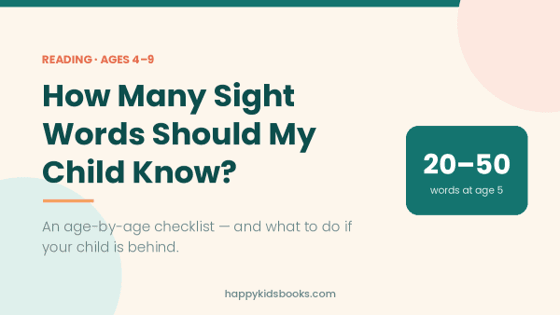
How many sight words should a 5, 6, 7 or 8 year old know? An age-by-age checklist, what counts as behind, and how to catch up with 10 minutes a day.
If you’ve watched another child in your daughter’s class read a whole page while yours is still stuck on because, you’ve probably asked the question: how many sight words should a 5 year old know — and is mine behind?
Here’s the honest answer up front: the ranges below are useful guides, not pass marks. Reading development is genuinely uneven, and a child who looks behind at five very often reads confidently by seven. But knowing the typical range helps you decide whether to relax or to add ten minutes of practice a day.
Quick Answer: Sight Words by Age
| Age | School stage (UK / US) | Typical sight words known | What reading looks like |
| 4 | Nursery / Pre-K | 0–20 | Recognizes own name, a few common words |
| 5 | Reception / Kindergarten | 20–50 | Reads very simple sentences with support |
| 6 | Year 1 / Grade 1 | 80–150 | Reads short books, still pausing often |
| 7 | Year 2 / Grade 2 | 150–250 | Reads more smoothly, fewer stops |
| 8 | Year 3 / Grade 3 | 250–300 | Reads with expression, handles longer words |
| 9 | Year 4 / Grade 4 | 300+ | Sight recognition largely automatic |
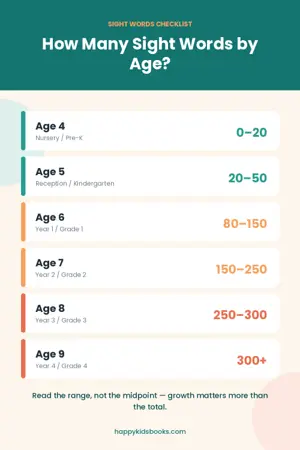
Read the range, not the midpoint. A six-year-old who knows 80 words is inside the normal range, not failing. The number that matters more than the total is whether the total is growing.
What Sight Words Actually Are (And Why the Count Matters)
Sight words are the high-frequency words a child should recognize instantly rather than sounding out — the, said, come, was, there, because, could, through.
They matter for two reasons:
- They’re everywhere. Roughly 100 words make up about half of everything a young child reads. Master those, and half the page becomes effortless.
- Many don’t obey phonics rules. A child sounding out s-a-i-d produces “sa-id”. These words have to be stored as whole units in memory.
Here’s the part most parents miss: sight words aren’t really about reading speed. They’re about freeing up brain space. A child spending effort decoding was has less capacity left to follow the story. That’s why sight word gaps often show up as comprehension problems rather than reading problems.
Is My Child Behind? Five Better Questions Than the Number
Before you compare counts with another parent, check these instead.
1. Is the number growing month to month?
A child who went from 30 to 45 words in a term is progressing normally, even if a classmate is at 90. Rate of growth matters more than position.
2. Do they recognize words out of context?
Some children memorize the shape of a page rather than the word. Test a word on a plain card, away from the book. If it disappears, they’re recognizing the story, not the word.
3. Are they willing to try?
Avoidance is a stronger warning sign than a low count. A child who says “you read it” every single time may be protecting themselves from repeated failure.
4. Are they reading word-by-word with no expression?
Flat, robotic reading usually means decoding is still taking up all their attention.
5. Do they confuse similar-looking words?
Mixing up were / where / when is completely normal at 5–6. Still doing it consistently at 8 is worth attention.
When to actually seek advice: if by the end of Year 1 / Grade 1 your child recognizes fewer than about 30 words, avoids reading entirely, or shows no growth over a full term, speak to their teacher. Not as an emergency — as a conversation. Early support is enormously effective and getting it early is a win, not a verdict.
Why the Numbers Vary So Much Between Children
Four things move a child’s count more than raw ability:
- Birth month. In a Reception class, the oldest child is nearly 20% older than the youngest. At five, that’s an enormous developmental difference — and it evens out by around age eight.
- Exposure at home. Books read aloud, labels, signs, subtitles on the TV. All of it counts.
- Visual memory. Sight words lean heavily on visual recall, which develops at different rates.
- Confidence. A child who believes they’re “bad at reading” practices less, which makes it true. This loop is the single most fixable factor on this list.
How Many Times Must a Child See a Word Before It Sticks?
Typically between 4 and 14 exposures — and for some children considerably more. This is the most reassuring fact in this whole article, because it means “my child forgot it again” is not a red flag. It’s the normal shape of learning.
It also explains why flashcards alone often disappoint. Fourteen exposures of the same card is boring. Fourteen exposures across tracing, finding, coloring, writing and reading in a sentence is varied enough that a child will actually do it.
The 10-Minute Routine That Moves the Number
Consistency beats duration. This fits into a normal weekday.
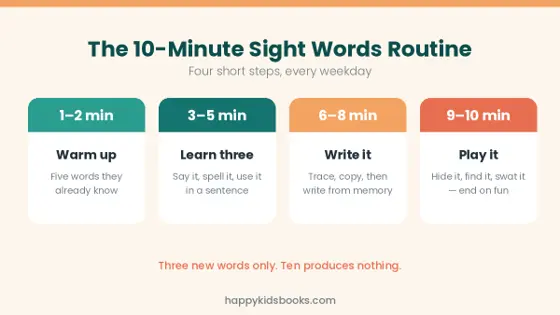
Minutes 1–2 — Warm up on wins. Five words your child already knows. Start with success.
Minutes 3–5 — Three new words. Only three. Say it, spell it aloud together, then use it in a sentence about their actual day: “We said goodnight to Grandma.”
Minutes 6–8 — Write it. Trace, copy, then write from memory. Handwriting builds a stronger memory trace than reading alone — this is why worksheet practice consistently outperforms flashcards used on their own.
Minutes 9–10 — Play it. Hide word cards around the room. Swat the word on the table. Find today’s word inside a real book. Finish on fun, and they’ll agree to it again tomorrow.
Every second week — review old words. Words fade. Bring back words from a month ago. This is the step almost everyone skips, and it’s the one that makes the total keep climbing.
Four Mistakes That Flatten Progress
Doing ten new words at once. Three sticks. Ten produces nothing and teaches your child that practice doesn’t work.
Turning practice into a test. Say “let’s practice”, never “let’s see if you remember”. The second one adds pressure to something that should feel neutral.
Practising at bedtime. Ten minutes after school with a snack beats twenty minutes with a tired child.
Comparing out loud. “Your sister knew these at five” costs you more progress than any worksheet will win back.
Ready-Made Practice: The Safari Sight Words Workbook
If you want the routine above without building it yourself, the Safari Sight Words Workbook for Kids Ages 5–9 is designed exactly around it.
Each word runs through a full practice cycle instead of a single flashcard glance:
- Trace and write — pencil control plus letter-order memory
- Find the word — recognition among similar-looking words
- Color the word — a low-pressure task that keeps younger children going
- Read it in a sentence — transferring the word into real reading
- Safari theme throughout — jungle characters on every page
It’s an instant PDF download, so you can print tonight’s page in two minutes and reprint any page as many times as your child needs. That reprinting matters: repetition is the whole mechanism, and a paper book you can only write in once fights against it.
→ Download the Safari Sight Words Workbook
Frequently Asked Questions
How many sight words should a 5 year old know?
Most five-year-olds recognize between 20 and 50 sight words. Anywhere in that range is typical, and children at the lower end very often catch up within a year.
How many sight words should a 6 year old know?
Around 80 to 150 by the end of Year 1 or Grade 1. The important measure is steady growth across the year rather than the total on any given day.
What if my child knows far fewer than the range?
Look at growth first — if the number is rising each month, keep going. If there’s been no movement across a full term, or your child avoids reading entirely, raise it with their teacher.
Should I teach sight words or phonics first?
Both together. Phonics handles decodable words; sight words handle the high-frequency ones that don’t decode neatly. They support each other rather than compete.
How long does each word take to learn?
Usually 4 to 14 exposures, sometimes more. Forgetting a word you practiced last week is normal, not a warning sign.
Do sight words matter if my child already reads well?
Yes — at ages 8–9 the focus shifts to longer high-frequency words like through, thought, enough, different, which trip up otherwise fluent readers.
Where to Start Tonight
Don’t count words tonight. Pick three, spend ten minutes, and end while your child is still enjoying it. Count again in a month — that comparison will tell you far more than any chart.
→ Get the Safari Sight Words Workbook for Ages 5–9
Younger child not yet at sight words? Build letter recognition first with the Preschool & Kindergarten Readiness Workbook for Ages 3–6.
Want the actual words? See the full kindergarten sight words list with a 10-minute weekly practice routine.
Get new printables in your inbox
Join other parents getting new printable pages, freebies and simple at-home learning tips. No spam, unsubscribe anytime.