
Decodable and leveled readers look alike but teach different things. Here's the difference, which one your child needs now, and how to use it in 10 minutes a day.
Your child brings home two books that look almost identical. Same trim size, same cheerful cover, same “Level 1” sticker on the front.
One of them is training your child to sound out words. The other might be training them to guess.
They’re not interchangeable, and knowing which is which changes how you spend your ten minutes of reading practice tonight.
The Short Answer
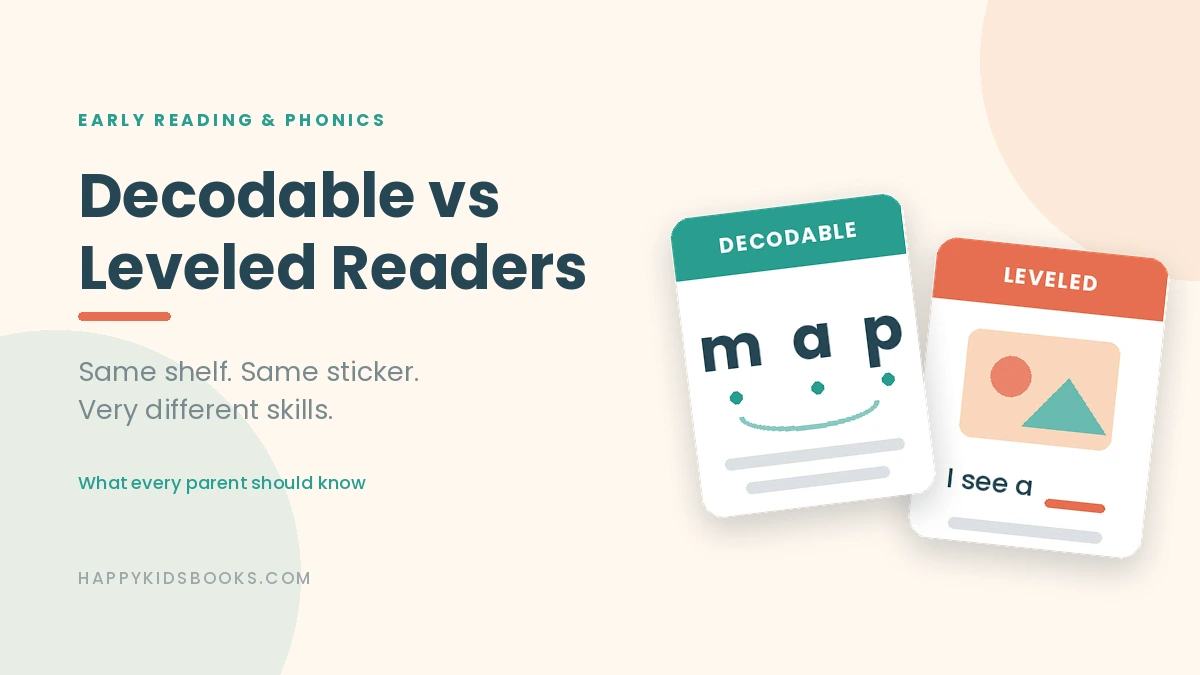
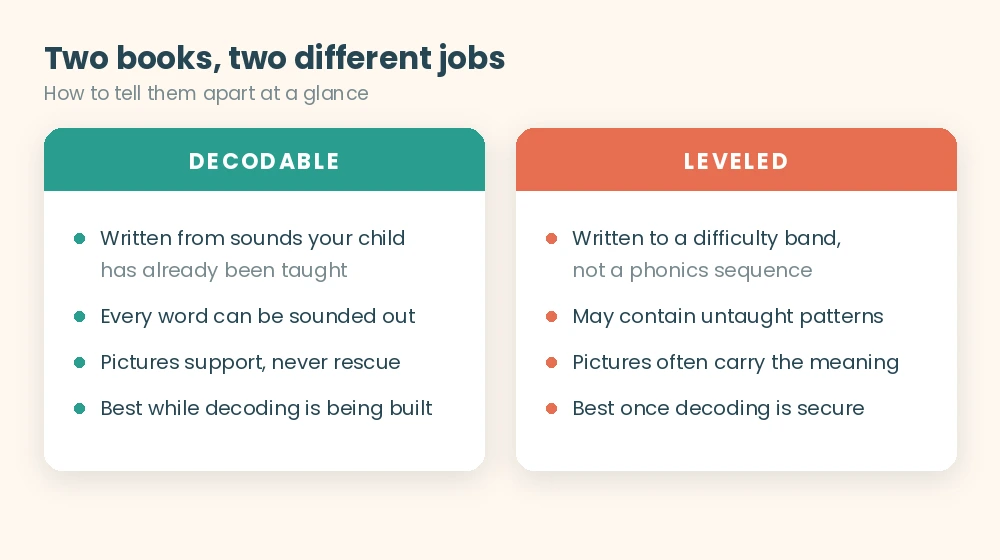
Decodable readers are written so a child can sound out nearly every word using phonics patterns they’ve already been taught. Leveled readers are sorted by overall difficulty — sentence length, vocabulary, picture support — regardless of whether the child has the phonics knowledge to decode the words.
If your child is still learning to sound out words, they need decodable text. Once they can decode confidently, leveled and general books take over.
Decodable vs Leveled Readers: Side by Side
| Decodable readers | Leveled readers | |
|---|---|---|
| Sorted by | Phonics patterns taught so far | Sentence length, vocabulary, difficulty |
| Word choice | Only sounds the child knows, plus 2–3 taught sight words | Any words that fit the difficulty band |
| Pictures | Support the story, not the words | Often carry the meaning of the sentence |
| Child can succeed by | Decoding — there’s no other route | Decoding, memorizing the pattern, or reading the picture |
| Best for | Children building sound-to-letter skill | Children who already decode fluently |
| Typical age window | Roughly ages 4–7 | Ages 6+ and onward |
| Main risk | Feels repetitive if poorly written | Rewards guessing over decoding |
Why the Difference Matters More Than It Looks
Leveled readers lean heavily on repeated sentence patterns: I see a dog. I see a cat. I see a bird.
A child can read that page beautifully without looking closely at a single word. They catch the pattern on line one, then use the picture to supply the last word. It sounds like reading. The pages turn. Everyone’s happy.
The trouble arrives around second or third grade, when sentences get longer, patterns disappear, and the pictures stop rescuing them. A child who built their reading on guessing hits a wall — and by then they’ve had two years of practice at the wrong skill.
Decodable text closes that escape route. The child has to look at the letters, because there’s nothing else to go on. Looking at the letters is the whole skill we’re trying to build.
What’s actually happening in your child’s brain
When a child successfully sounds out ship four or five times across a story, the spelling, the sound, and the meaning start binding together. After enough correct reads, the word stops being decoded and simply becomes known on sight.
Reading researchers call this orthographic mapping. Parents call it “wait, she just read that without stopping.”
Here’s the part that surprises people: you can’t shortcut it with flashcards of whole words. The binding happens through successful decoding, repeated. That’s precisely what decodable passages are engineered to deliver.
There’s a confidence effect too, and it’s underrated. A child who sounds out a page correctly feels capable. A child who guesses wrong four times a paragraph feels stupid — and children who feel stupid stop volunteering to read. Decodable text is deliberately winnable. That’s not lowering the bar; it’s putting the bar where the child can reach it, then moving it.
When Should My Child Start Decodable Readers?
Your child is ready when they can do three things:
- Know some letter sounds. Not all 26 — five or six consonants plus one or two short vowels is enough to begin.
- Blend two or three sounds. If you say /m/ /a/ /p/ slowly and they say map, they’re ready.
- Track left to right. They can point under words in order without jumping around the page.
Most children reach this between ages four and six. The range is wide and completely normal. If you’re unsure where your child sits, the kindergarten readiness checklist walks through the early literacy signals in more detail.
If letter sounds are still shaky, start there instead — hands-on letter and sound work like the activities in the Little Learner Activity Book builds the foundation decodable text sits on.
How to Use a Decodable Passage at Home
Ten minutes. Not thirty. This sequence works:
1. Warm up the sounds (1 min). Find the pattern the passage practices. If it’s short e, say a few short e words together before opening the page.
2. Preview the tricky words (1 min). Point out the two or three irregular words — the, said, of. Read them aloud. Don’t make your child sound these out; just tell them.
3. First read, slow and out loud (4 min). Your child reads. You sit on your hands.
When they stall, wait a full three seconds before helping. Most children solve it in second two. If they’re still stuck, don’t say the word — point under the letters and say, “Sound it out.” Still stuck? Tell them the word and move on. Never let a struggle run past about eight seconds.
4. Second read, smoother (2 min). Same passage again. It’ll be noticeably faster — say so. This is where fluency is built, and it’s the step almost every family skips.
5. Talk about it (2 min). One question. What happened? Who was in it? What was funniest? This keeps decoding tied to meaning.
Reread the same passage across two or three days before moving on. Rereading isn’t wasted time. It’s the point.
Stories your child can actually read
Our Decodable Passages Pack has short illustrated stories with comprehension questions, sequenced from simple CVC words up. Grades K to 2, instant PDF download.
What Makes a Good Decodable Passage?
Not all decodable material is equal. Plenty of it is technically decodable and completely joyless. Look for:
- One clear phonics focus per passage — not five patterns crammed together
- Controlled irregular words — two or three per story, introduced gradually
- An actual story — something happens, someone wants something. Even at 40 words, a passage can have a beginning and an end
- Single-storey letterforms — where the a and g are shaped the way a child writes them by hand. Fonts like Poppins get this right, and mismatched letterforms genuinely slow early readers down
- Comprehension questions attached — decoding and understanding practiced together from day one
- Enough passages to build a habit — one story is a nice afternoon; thirty is a reading routine
Where Sight Words Fit
Parents often ask whether decodable readers replace sight word practice. They don’t — the two run in parallel.
Decodable passages handle the regular patterns, which cover the large majority of English. Sight word practice covers the small set of high-frequency words that break the rules and have to be learned as wholes. Skip either one and there’s a gap.
If you want a structured way to cover the second piece, the Safari Sight Words Workbook works through the core list with tracing, matching, and sentence practice.
Four Mistakes to Avoid
Correcting every error instantly. Give three seconds. Self-correcting is a skill, and it only develops if there’s a gap in which to do it.
Choosing books above the phonics level. A beautiful picture book your child can’t decode is a book for you to read aloud. Both things should happen — just don’t confuse them.
Reading for too long. Ten focused minutes daily beats forty minutes on a Sunday. Every time.
Skipping the reread. It feels redundant. It’s where fluency comes from.
Ready to Go Further?
If these first stories work for your child, the full Decodable Passages Pack continues the sequence — 32 illustrated stories across 85 printable pages, ordered by phonics pattern from CVC words upward, with comprehension questions throughout.
Instant PDF download, so tonight’s story is two minutes away. Print single passages as you need them, or run the whole pack as a term of reading practice.
Frequently Asked Questions
Are decodable readers boring? Older ones often were. Modern decodable passages are written as real short stories with characters and a plot — the constraint is on which sounds appear, not on whether anything interesting happens.
How long should my child use decodable readers? Usually through kindergarten and first grade, tapering as phonics knowledge broadens. Once your child can decode most words in an ordinary children’s book, they’ve outgrown the need.
My child’s school uses leveled readers. Is that a problem? Not necessarily, and it’s not worth a fight. Ten minutes of decodable practice at home covers the gap without contradicting their teacher.
Can I just read picture books instead? Read picture books aloud to your child daily — that builds vocabulary, knowledge, and love of story. But for the reading your child does themselves, decodable text is what builds the decoding skill.
What if my child memorizes the passage? Normal on rereads, and fine. To check the decoding is real, point to one word out of order and ask them to read just that one.
Happy Kids Books makes instant-download printable workbooks for children ages 3–9. Browse the Early Reading & Phonics collection for more phonics and decoding practice.
Get new printables in your inbox
Join other parents getting new printable pages, freebies and simple at-home learning tips. No spam, unsubscribe anytime.