

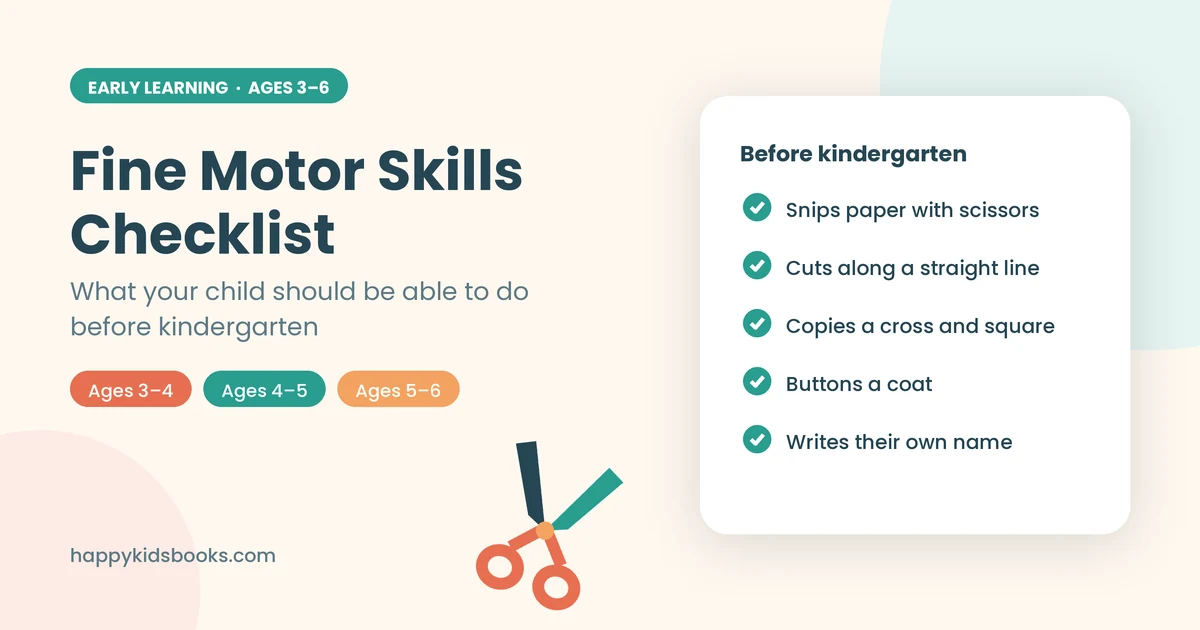
A parent-friendly fine motor skills checklist for ages 3, 4 and 5, plus simple at-home activities to build cutting, drawing and pencil grip.
Your child can name every dinosaur and count to twenty. But they still hold a crayon in their fist, and handing them scissors makes you nervous.
That gap is completely normal. Fine motor skills — the small, precise movements of the hands and fingers — develop on their own timeline, separate from talking, reading or counting. They’re also the skills a kindergarten classroom leans on constantly: holding a pencil, cutting on a line, opening a lunchbox, zipping a coat, turning one page at a time.
Below is a plain-English checklist of what most children can do at ages 3, 4 and 5, along with easy ways to build each skill at home. No therapy equipment required.
First, a quick note on ranges
Every list like this describes a typical range, not a deadline. Some children cut beautifully at three and still can’t manage a button at five. Prematurity, left-handedness and simply not having had much practice all shift the timeline.
Use the checklist to spot what to practice, not to grade your child. If your child is well behind most items in their age group, or if you notice hand tremors, a strong preference for avoiding hand activities, or frustration that leads to real distress, it’s worth mentioning to your pediatrician, who can refer you to an occupational therapist.
Ages 3 to 4: building hand strength
At this stage, the goal is strength and control — not neatness.
- Snips paper with scissors (single cuts, not along a line)
- Strings large beads onto a lace
- Copies a vertical line and a circle
- Builds a tower of nine or ten blocks
- Turns book pages one at a time
- Eats with a fork and spoon reasonably well
- Undoes large buttons and pulls a zip that’s already started
- Holds a crayon with fingers rather than a whole fist
What helps: Play dough is the single most useful thing you can own. Rolling, pinching and squashing build the exact hand muscles a pencil needs. Tearing paper, popping bubble wrap, using tongs to move pom-poms between bowls, and threading pasta onto string all do the same job while feeling like play.
Coloring counts too, as long as you don’t mind it being messy. Large, bold shapes with plenty of white space suit this age far better than fussy detail. Our Printable Baby Animal Coloring Book uses thick outlines and simple shapes for exactly that reason.
Ages 4 to 5: cutting and controlled marks
Now precision starts to appear. Children begin aiming for a target rather than just moving the tool.
- Cuts along a straight line, staying roughly on it
- Cuts a large curve or a gentle wavy line
- Copies a cross and a square
- Draws a person with two to four recognizable parts
- Threads smaller beads
- Buttons medium buttons and starts a zip independently
- Unscrews jar lids
- Uses a tripod grasp on a pencil (thumb and two fingers) at least some of the time
What helps: Cutting practice needs to be progressive. Handing a four-year-old a picture to “cut out” is too big a jump — they need straight lines first, then wide zigzags, then gentle curves, then shapes. Sheets designed in that order make a noticeable difference within a couple of weeks.
That progression is exactly how our Scissor Skills Workbook is built: it starts with short straight snips and works up to curves and simple shapes across the whole book, so your child is always cutting something just slightly harder than the last page. It’s an instant download, so you can print one page a day rather than buying a book that gets scribbled through in an afternoon.
A practical tip most parents don’t hear: check the scissors. Cheap plastic safety scissors that don’t actually cut are the number one reason children give up. Look for proper child scissors with blunt tips and metal blades, and make sure they match your child’s dominant hand.
Ages 5 to 6: pencil control for writing
This is the year fine motor skills become academic. Handwriting, drawing and cutting all feed into daily classroom work.
- Cuts out simple shapes like a circle and a square
- Copies a triangle
- Draws a person with six or more parts
- Writes their own first name, even if letters are uneven
- Uses a consistent tripod grasp
- Colors mostly within the lines
- Ties a beginning knot; some children start on laces
- Spreads with a butter knife
What helps: Anything that asks for a controlled, continuous line. Mazes, tracing, and dot-to-dot puzzles are all quietly training the same movement a letter needs — starting at a point, controlling the path, stopping deliberately.
Dot-to-dot is especially good value here because it does double duty: number recognition and pencil control in the same activity, with a picture as the reward at the end. Our Dot-to-Dot Workbook runs 72 pages and scales from short low-count puzzles up to longer sequences, so it grows with your child rather than being outgrown in a week.
If your child is working on several readiness areas at once, the Little Learner Activity Book mixes fine motor pages with early letters, numbers and matching for ages 3–6.
Five habits that build fine motor skills without any worksheets
Worksheets are useful, but daily life offers more practice than any book. These cost nothing:
- Let them do the fastenings. Buttons, zips and Velcro on their own coat, every single day. It’s slower. Do it anyway.
- Hand over kitchen jobs. Tearing lettuce, stirring batter, peeling a satsuma, sprinkling toppings, spreading butter.
- Use small tools. Tweezers, clothes pegs, spray bottles, hole punches, sticker sheets. Peeling stickers off a backing sheet is a surprisingly good pincer workout.
- Draw on vertical surfaces. Tape paper to a wall, or use an easel or a chalkboard. Drawing upright strengthens the wrist and shoulder, which is where a stable pencil grip actually starts.
- Break crayons in half. Short crayons physically cannot be fist-gripped. It’s the simplest grip fix there is.
How much practice is enough?
Ten to fifteen minutes a day beats an hour on Sunday. Fine motor development is about repetition, and small hands tire quickly — pushing past the point of fatigue usually just teaches a child that pencils are miserable.
Stop while it’s still fun. That’s the whole strategy.
Frequently asked questions
At what age should a child hold a pencil correctly? Most children settle into a tripod grasp between four and six. Before that, a range of grips is normal. Short crayons, vertical drawing surfaces and hand-strengthening play will do more than correcting their fingers will.
Should I correct my child’s pencil grip? Gently, and rarely. Constant correction tends to make children avoid drawing altogether. Change the tool instead of the child: broken crayons, chunky triangular pencils or a pencil grip attachment usually fix the position on their own.
My child hates cutting. What now? Check the scissors work, check they’re the right hand, and lower the difficulty. Most cutting refusal is a difficulty problem, not a stubbornness problem. Go back to snipping the edge of a strip of paper into a bowl, with no line to follow at all, and build up from there.
Are fine motor skills part of kindergarten readiness? Yes — and they’re often the piece parents overlook while focusing on letters and numbers. Our kindergarten readiness checklist covers the full picture, including social, language and self-care skills.
Start with one skill this week
Pick the single item on the checklist your child finds hardest and work only on that for a week. One skill, ten minutes a day. That’s how this progresses — not through a big push, but through small, unremarkable, daily practice.
If cutting is that skill, our Scissor Skills Workbook gives you a printable page a day in the right order, and downloads instantly so you can start this afternoon.