
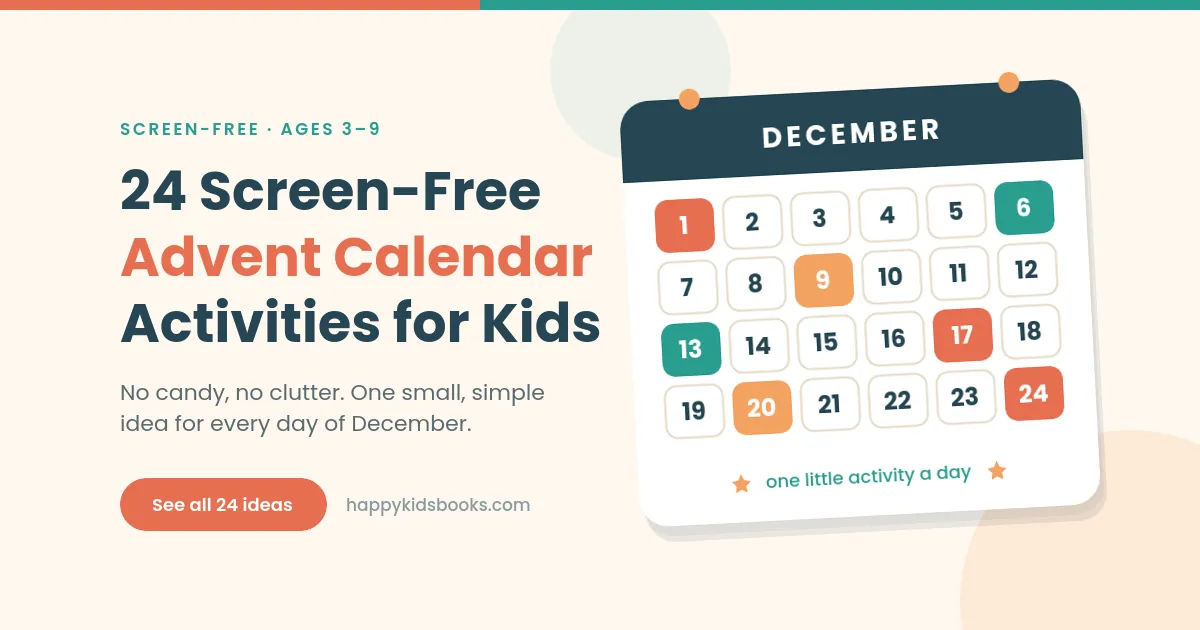
24 screen-free advent calendar activities for kids ages 3-9 - simple daily ideas that make December feel special without candy or plastic toys.
Quick answer
A screen-free advent calendar swaps candy and toys for one small activity each day in December, such as a winter walk, a holiday story or a coloring page. Write 24 activities on slips of paper and put them in numbered envelopes, a jar or a paper chain. Match the activities to your child’s age and keep busy days extra simple.
Every year it’s the same deal. You walk past the seasonal aisle in October and there they are: rows of cardboard calendars with twenty-four little doors, each one hiding a waxy chocolate or a tiny plastic figure that will be under the couch by December 3rd.
There’s nothing wrong with those. But a lot of parents want December to feel like something other than a month-long sugar drip and a pile of new stuff to store. That’s where screen-free advent calendar activities come in. Instead of an object behind each door, you put an activity — a small thing you do together that takes ten or twenty minutes and costs almost nothing.
Below are 24 of them, organized so the effort stays manageable across the month. Plus how to adjust them for different ages, and the three things that decide whether this actually lasts past the first week.
Why parents are moving away from candy and toy calendars
Three reasons come up over and over:
- The sugar. Twenty-four days of chocolate before breakfast, on top of every holiday party and cookie exchange, is a lot for a small body.
- The clutter. Tiny toys arrive in December and get thrown out in January. Nobody feels good about that.
- It’s over in ten seconds. Open the door, eat the thing, walk away. There’s no moment in it.
An activity calendar flips that. The countdown becomes twenty-four small pockets of time you actually spend with your kid — which, when you look back at photos in February, is the part you remember.
How an activity advent calendar actually works
You need somewhere to put twenty-four slips of paper. Pick whichever of these you’ll actually finish:
- The envelope string. Twenty-four small envelopes numbered 1 to 24, pegged to a length of twine across a doorway or mantel. Ten minutes to set up.
- The jar. One jar, twenty-four folded slips. Your child pulls one each morning. Zero setup, zero wall space.
- The paper chain. Twenty-four paper strips, activity written on the inside, looped into a chain. Your child tears one off each day and the chain visibly shrinks. Little kids love watching it get shorter.
One tip that saves you: write the activities in pencil and don’t commit to a fixed order. Some days you’ll have an hour. Some days you’ll have eight minutes and a bad mood. Being able to swap a slip is the difference between finishing the month and quitting on day nine.
24 screen-free advent calendar activities
Days 1–6: Easing in
Start light. Early December is already busy and you want quick wins.
- Hot chocolate taste test. Make two kinds and vote on the winner. Bonus points for a scoring sheet.
- Read a holiday book under a blanket fort. The fort is the whole event. The book is a bonus.
- Paper snowflakes. Fold, cut, unfold. Tape them to a window and leave them up all month.
- Christmas lights drive. Pajamas on, thermos in the cupholder, one loop around the neighborhood.
- Decorate the tree together — but let your child place the ornaments wherever they want, including the six on one branch.
- Write a letter to Santa (or to a grandparent, or to next-year’s self). Any letter counts.
Days 7–12: Making things
The middle stretch is where hands-on projects land best, because the excitement is high but the schedule hasn’t collapsed yet.
- Salt dough ornaments. Flour, salt, water. Bake low, paint the next day.
- Cinnamon and orange garland. Dried orange slices on string. The house smells incredible for a week.
- Build a gingerbread house — kit, graham crackers, whatever’s easiest. Structural failure is part of it.
- Homemade wrapping paper. Butcher paper plus potato stamps or handprints.
- Make a card for the mail carrier and tape it to the mailbox.
- Family recipe night. Cook one thing your child has never helped make before.
Days 13–18: Giving and kindness
This block is the one parents tell me makes the biggest difference. It’s also the easiest to skip, so put it in the middle where you’ll still have energy.
- Pick three toys to donate. Let your child choose. Don’t override the choices.
- Grocery run for the food bank. Give them a five-dollar budget and let them pick the items.
- Draw a picture for a neighbor and deliver it in person.
- Call or video a relative your child hasn’t spoken to in a while.
- Leave a thank-you note and a snack for a delivery driver.
- Compliment jar. Everyone in the family writes one nice thing about each other person, then you read them at dinner.
Days 19–24: The home stretch
School’s out, energy is up, patience is down. Keep these short and low-prep.
- Christmas movie in a sleeping bag on the living room floor. (Yes, this one has a screen. One night out of twenty-four is fine.)
- Cookie decorating with more sprinkles than structurally advisable.
- Pajama day. The whole activity is that nobody gets dressed.
- Sing carols in the car at full volume on the way to the store.
- Track Santa on the radar and set out cookies.
- Open one small gift on Christmas Eve — traditionally new pajamas.
How to match activities to your child’s age
The same list works from three to nine, but the framing changes.
Ages 3–5. Keep it to fifteen minutes and expect them to lose interest halfway through. That’s fine — the point was the fifteen minutes, not the finished product. Cutting and pasting activities are especially good here because they build the hand strength kids need for writing later. If scissors are new territory, our guide on teaching a 3-year-old to use scissors covers what to expect at this age.
Ages 5–7. This group can handle multi-step projects and genuinely enjoys the giving activities. Let them read the daily slip out loud — it’s real reading practice wrapped in something fun.
Ages 7–9. Give them ownership. Let them write some of the slips in November, or put them in charge of one day a week. Older kids drop out of family traditions fast when they feel managed rather than included.
The lowest-effort version: one printable page a day
If the envelope-and-twine setup already sounds like too much, here’s the version that survives real life: print a stack of activity or coloring pages, put one behind each day, and let that be the whole calendar.
It works because it removes the daily decision. There’s no scrambling at 7 a.m. wondering what today’s activity is — the page is the activity. Kids sit with it for fifteen or twenty minutes, and you get to drink your coffee while it’s still hot.
Dot-to-dots are a good fit for this because they hold attention longer than plain coloring; we broke down which formats work at which ages in what age a child can do dot-to-dots. For younger kids, a simple printable coloring book gives you enough pages to cover the whole month with room to spare. And if you’re not sure which level fits your child, our printable workbooks by age guide sorts it out quickly.
Three things that make it actually stick
Plan for eleven days, not twenty-four. Roughly half your slips should take under fifteen minutes. If every day is a project, you’ll burn out in the first week and the calendar becomes a guilt object hanging in the hallway.
Attach it to a time you already have. After breakfast, or right before bed. A tradition anchored to an existing routine survives. A floating one doesn’t.
Let them skip. Some days your kid won’t want to do it. Let the slip go back in the jar. The moment it becomes an obligation, it stops being the good part of December — and the whole reason to do this instead of chocolate was that it felt like something, not like homework.
If you’re building out more low-tech options for the rest of the year, our list of screen-free activities for kids covers the non-holiday version of the same idea.
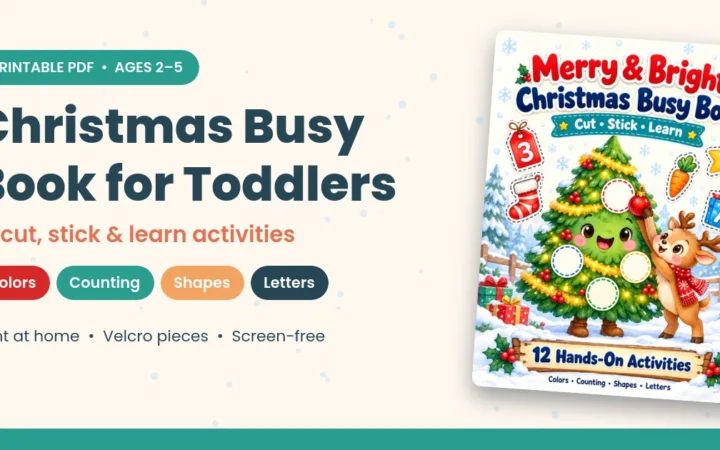
New: the Merry & Bright Christmas Busy Book
12 cut-and-stick Christmas activities for ages 2 to 5: colors, counting, shapes, letters and more. A printable PDF you can download today. See what’s inside.
Frequently asked questions
When should I set up an activity advent calendar?
Late November is ideal. Write your slips over a weekend so December 1st doesn’t sneak up on you. If you’re reading this in September, put a note in your calendar for the week of Thanksgiving.
Do I need 24 different activities?
No. Repeating a few favorites is completely normal, and kids often prefer it. Twelve activities used twice works fine.
What if we miss a day?
Double up the next day or drop that slip entirely. Nobody is counting. Missing days is the most common reason families abandon the whole thing, and it’s the least necessary one.
Does this work for non-Christmas households?
Yes. Strip out the tree and Santa entries and you have a December kindness-and-connection countdown that works for any family. Several of the giving activities are the strongest ones on the list anyway.
Start small
You don’t need a Pinterest-worthy setup. A jar, twenty-four slips of paper, and a willingness to skip the hard days is genuinely enough. The kids won’t remember whether the envelopes matched. They’ll remember that in December, there was a thing you did together every morning.
Get new printables in your inbox
Join other parents getting new printable pages, freebies and simple at-home learning tips. No spam, unsubscribe anytime.