
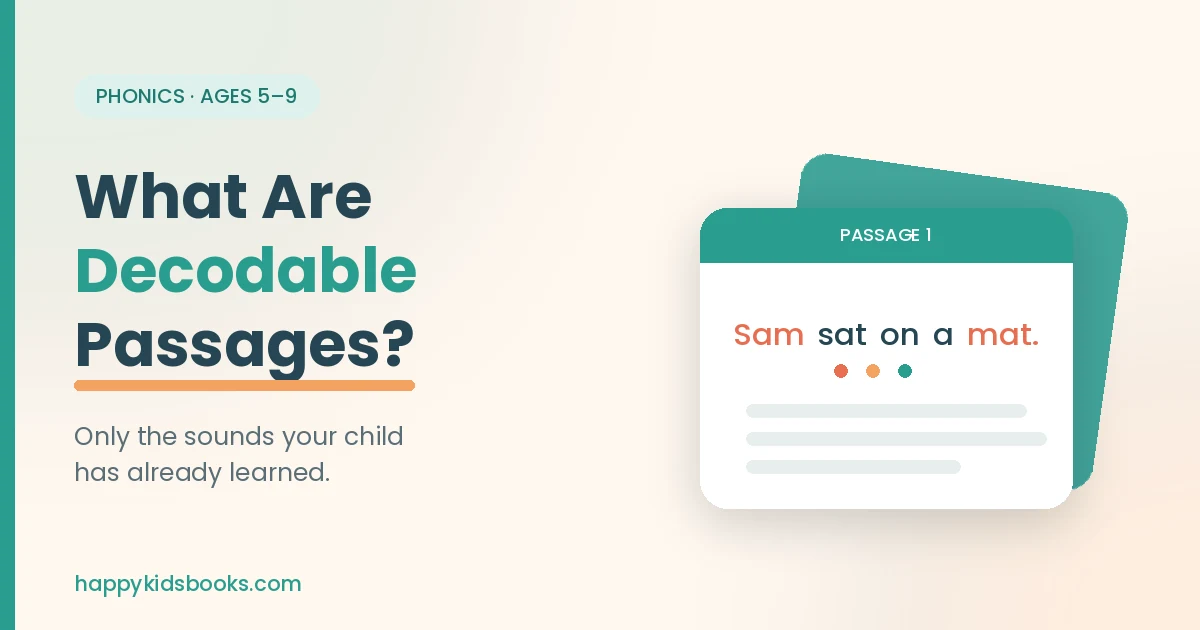
Decodable passages are short texts built only from phonics patterns your child has already learned. Here is how they differ from decodable books, and when to use each.
If your child’s teacher has mentioned decodable passages, or you’ve seen the term on a worksheet, you may be wondering how they differ from the decodable books already on your shelf.
The short answer: a decodable passage is a short piece of text, usually a paragraph or a page, built entirely from letter-sound patterns your child has already been taught. A decodable book is the same idea stretched across a whole story with illustrations.
The difference sounds small. In practice it changes how you use them.
The core idea: nothing your child hasn’t learned yet
Most books written for beginning readers contain words no beginner can actually read.
Think about a typical early reader. It might include friend, because, or little. Each of those contains a spelling pattern that isn’t taught until well after a child has learned basic consonants and short vowels. So when a five-year-old meets those words, they can’t sound them out. They guess — from the picture, from the first letter, from what the sentence seems to be building toward.
Guessing feels like reading. It isn’t.
Decodable text removes the guesswork. If your child has learned short a, m, s, t, and p, then a decodable passage at that stage uses only those sounds: Sam sat. Sam has a map. Every word is solvable with what they already know.
The technical term for this is controlled vocabulary. The practical term is: your child can actually read it.
Passages vs. books: which does what
Both have a place. They just solve different problems.
Decodable books work well for:
- Building the habit of reading a whole story
- Motivation, since finishing a book feels like an achievement
- Bedtime reading and independent practice
- Comprehension, because there’s a plot to follow
Decodable passages work well for:
- Targeted practice on one specific pattern
- Short sessions, five to ten minutes
- Repeated reading to build fluency
- Spotting exactly which sound your child is stuck on
The practical difference is scope. A book covers a lot of ground and you can’t easily tell which pattern tripped your child up. A passage focused on sh and ch tells you immediately.
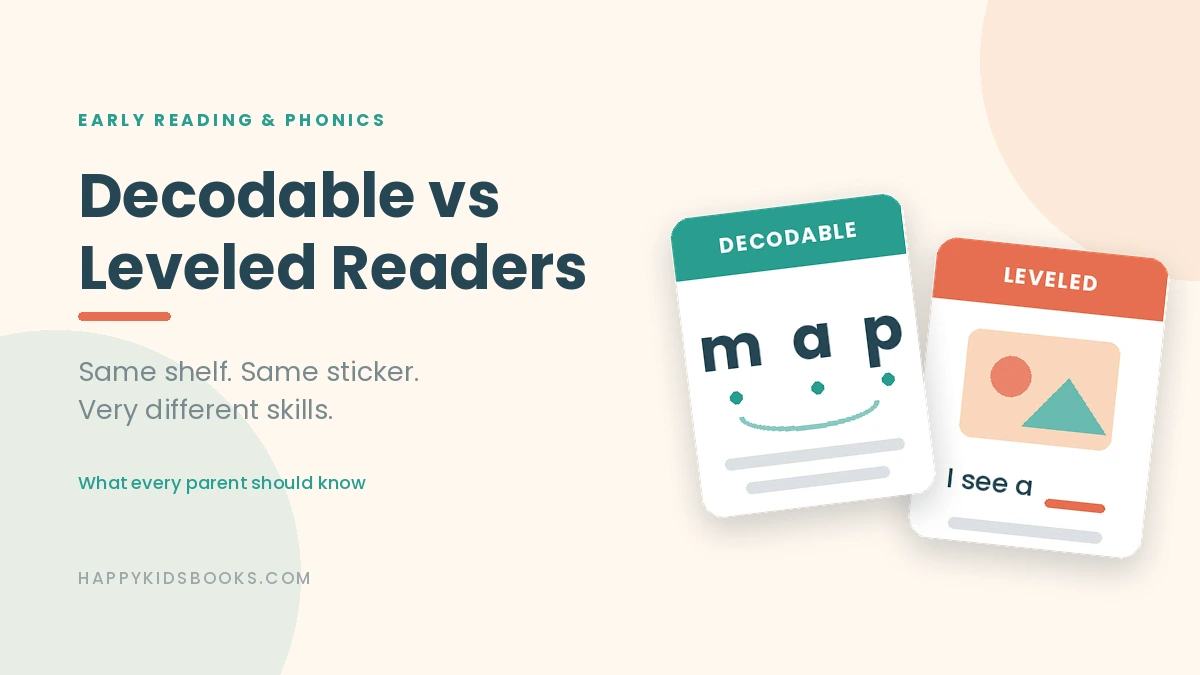
If your child is progressing steadily, books are enough. If they’ve hit a wall on a specific sound, passages are the more precise tool. (For more on choosing between text types, see our guide to decodable vs leveled readers.)
Why the “already learned” part matters so much
There’s a reason this approach caught on, and it’s worth understanding rather than taking on faith.
When children read a word by sounding it out successfully, and do that repeatedly, the word eventually stops needing to be sounded out. It becomes instantly recognizable. Researchers call this orthographic mapping — the process by which a word moves from effortful decoding into instant retrieval.
The key point is that this process runs on successful decoding. A child who guesses a word from the picture doesn’t get that benefit, because they never connected the letters to the sounds. They’ve memorized a shape, not learned a word.
This is why the “only patterns already taught” rule isn’t fussiness. It’s the whole mechanism. It’s also why sight words and phonics work together rather than competing.
An honest word about the research
You’ll find plenty of confident claims online that decodable text is proven superior. The picture is more nuanced, and it’s worth knowing where the evidence is strong and where it isn’t.
Strong: systematic phonics instruction works. The National Reading Panel’s 2000 review found systematic phonics produced better outcomes than unsystematic or no phonics instruction, particularly for younger children and those at risk of reading difficulty. This is about as settled as education research gets.
Less settled: the optimal degree of decodability. Reviews of decodable text research have generally found the evidence base thinner than people assume — studies vary widely in how they define decodability, and there’s no agreed threshold for how decodable a text needs to be.
What this means for you as a parent: use decodable text because the logic is sound and children can genuinely read it, not because a study proved a specific percentage. Don’t let anyone sell you a rigid system on the basis of settled science that isn’t settled.
How to use decodable passages at home
Keep sessions short. Five to ten minutes beats thirty. A frustrated child learns less than a child who stops while still willing.
Read the same passage more than once. First read is decoding, and it will be slow. Second and third reads build fluency. This repetition is where a lot of the value sits, and it’s the thing most parents skip.
Don’t supply the word too quickly. When your child stalls, wait. Count to five silently. Then prompt with the sound rather than the word: what does this letter say? rather than that says “ship.”
Watch for the pattern in the errors. One missed word is nothing. The same type of error three times is information — that’s the sound to go back to.
Stop before frustration, not after. Ending on a success makes tomorrow’s session easier. Ending on a struggle makes it harder.
When decodable text is the wrong choice
It’s worth being clear about the limits.
Decodable text is for practicing decoding. It isn’t meant to be your child’s whole reading diet, and controlled vocabulary means the stories are simpler than what a child can understand.
So keep reading aloud to your child from real books, well above their decoding level. Their listening comprehension runs far ahead of their reading ability at this age, and that gap is where vocabulary and love of story get built. Decodable passages train the mechanics. Read-alouds do everything else.
Both. Not one instead of the other.
Where to start
If your child is just beginning, start with short vowels and single consonants and don’t rush. If they’re reading simple words confidently but stumbling on longer ones, digraphs and blends are usually the next gap.
Our Decodable Passages Printable Pack contains 32 stories across 85 pages, sequenced so each one only uses patterns introduced earlier in the set. Print what you need, in order, and work through at whatever pace suits your child.
For children who need sight-word practice alongside their phonics work, the Safari Sight Words Workbook covers the high-frequency words that genuinely do have to be learned by sight.